
TAAT e-catalog
for
Development partners
https://e-catalogs.taat-africa.org/org/technologies/kichawi-kill-striga-bioherbicide
Mitigating Africa’s worst pest threat to food security by revolutionizing crop protection with a biological and sustainable weed control alternative.
This technology is a selective biological herbicide that farmers apply as a seed coating to boost their crop yields. This groundbreaking innovation is one of the first bioherbicides to be commercialized worldwide. It uses strains of a specific Kenyan fungus, Fusarium oxysporum f.sp. strigae, which have been selected for their ability to over-produce certain amino acids that kill Striga (witchweed) without harming maize. Normally, Fusarium oxysporum isn’t strong enough to protect crops from Striga. However, by choosing a strains that over-produces specific amino acids, the fungus can effectively reduce Striga infestation and restore crop yields. This is the first technology to combine the benefits of amino acid inhibition with fungal pathogens.
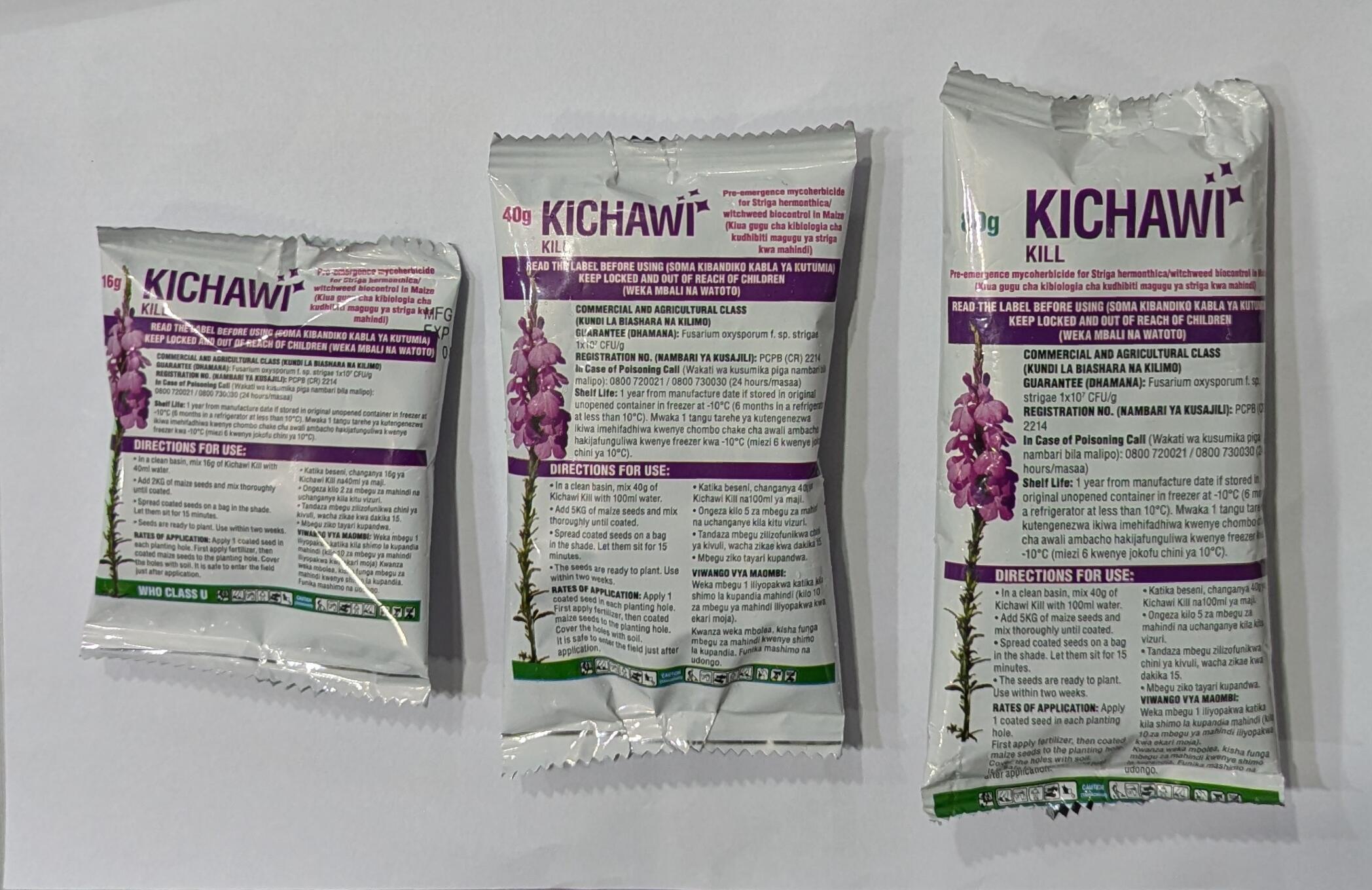
This technology is validated.
Adults 18 and over: Positive high
The poor: Positive high
Women: Positive medium
Climate adaptability: Highly adaptable
Farmer climate change readiness: Significant improvement
Kichawi Kill is a selective biological herbicide that controls Striga (witchweed) through seed coating technology, improving maize and sorghum productivity while reducing dependence on chemical herbicides. The technology can be integrated into cereal value chain development, food security, sustainable crop protection, climate-smart agriculture, integrated weed management, and rural livelihood programs to enhance farm productivity and environmental sustainability. Its adoption contributes to SDGs 1 (No Poverty), 2 (Zero Hunger), 5 (Gender Equality), 8 (Decent Work and Economic Growth), 9 (Industry, Innovation and Infrastructure), and 15 (Life on Land).
To integrate this technology into your project, plan and budget for the following activities and prerequisites:
Scaling Readiness describes how complete a technology's development is and its ability to be scaled. It produces a score that measures a technology's readiness along two axes: the level of maturity of the idea itself, and the level to which the technology has been used so far.
Each axis goes from 0 to 9 where 9 is the “ready-to-scale” status. For each technology profile in the e-catalogs we have documented the scaling readiness status from evidence given by the technology providers. The e-catalogs only showcase technologies for which the scaling readiness score is at least 8 for maturity of the idea and 7 for the level of use.
The graph below represents visually the scaling readiness status for this technology, you can see the label of each level by hovering your mouse cursor on the number.
Read more about scaling readiness ›
Uncontrolled environment: validated
Used by some intended users, in the real world
| Maturity of the idea | Level of use | |||||||||
| 9 | ||||||||||
| 8 | ||||||||||
| 7 | ||||||||||
| 6 | ||||||||||
| 5 | ||||||||||
| 4 | ||||||||||
| 3 | ||||||||||
| 2 | ||||||||||
| 1 | ||||||||||
| 1 | 2 | 3 | 4 | 5 | 6 | 7 | 8 | 9 | ||
| Country | Testing ongoing | Tested | Adopted |
|---|---|---|---|
| Cameroon | Testing ongoing | –Not tested | –Not adopted |
| Ethiopia | Testing ongoing | –Not tested | –Not adopted |
| Ghana | Testing ongoing | –Not tested | –Not adopted |
| Kenya | –No ongoing testing | Tested | Adopted |
| Nigeria | Testing ongoing | –Not tested | –Not adopted |
| Uganda | Testing ongoing | –Not tested | –Not adopted |
This technology can be used in the colored agro-ecological zones. Any zones shown in white are not suitable for this technology.
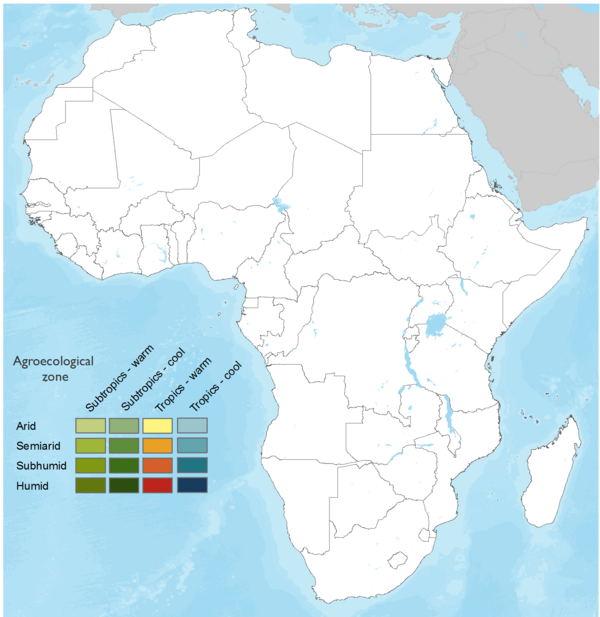
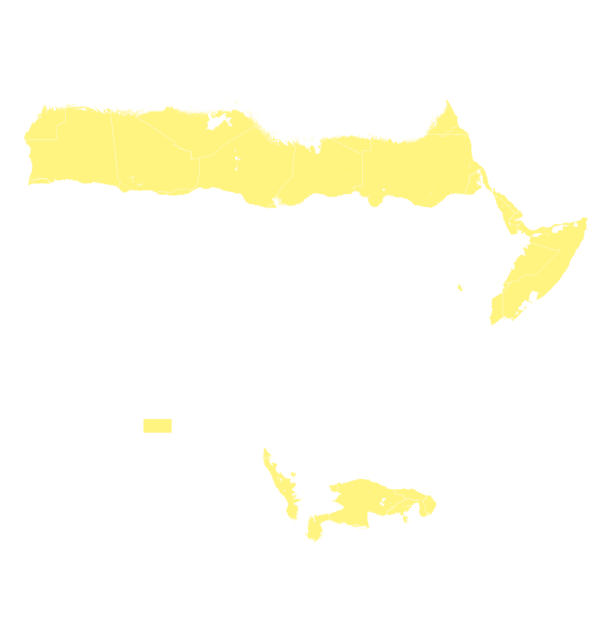
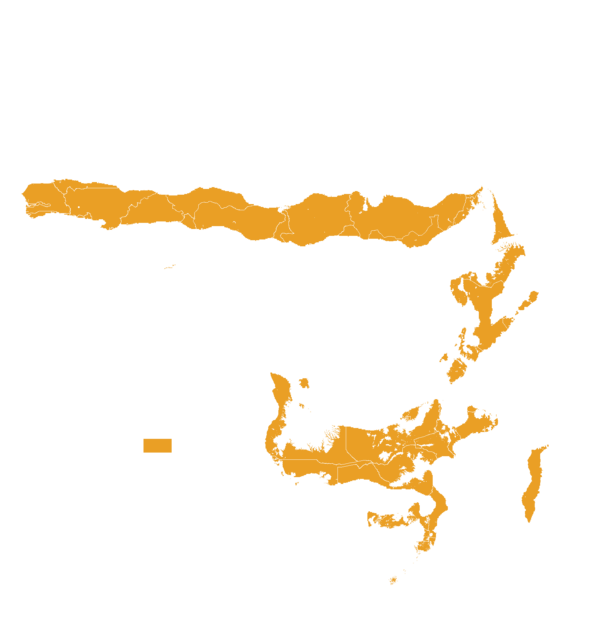
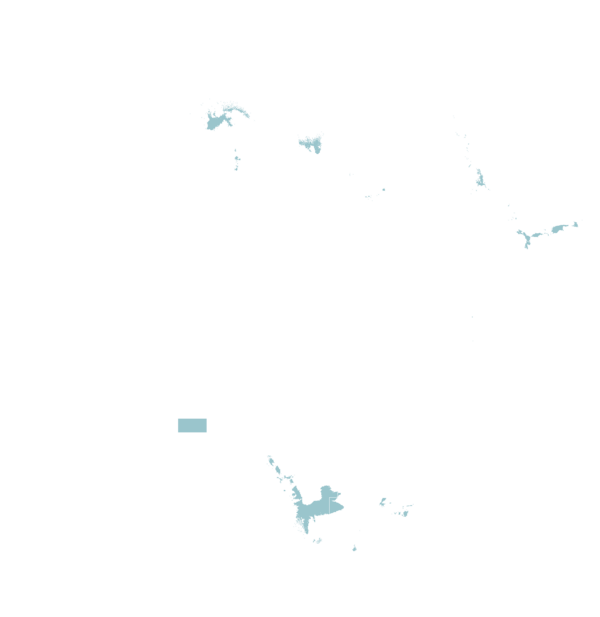

| AEZ | Subtropic - warm | Subtropic - cool | Tropic - warm | Tropic - cool |
|---|---|---|---|---|
| Arid | – | – | ||
| Semiarid | – | – | ||
| Subhumid | – | – | – | – |
| Humid | – | – | – | – |
Source: HarvestChoice/IFPRI 2009
The United Nations Sustainable Development Goals that are applicable to this technology.






Kichawi Kill is administered by:
Last updated on Sep 9, 2026
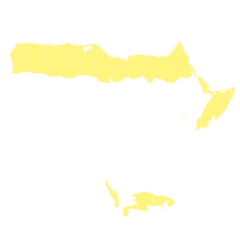
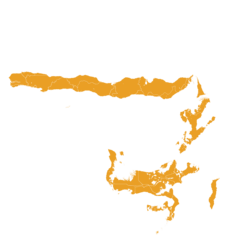
This technology can be used in the colored agro-ecological zones.



Kichawi Kill: Striga Bioherbicide
https://e-catalogs.taat-africa.org/org/technologies/kichawi-kill-striga-bioherbicide
Last updated on 9 September 2026, printed on Oct 24, 2026
Enquiries e-catalogs@taat.africa