Logo
TAAT e-catalog for Development partners
https://e-catalogs.taat-africa.org/org/technologies/livestock-feed-pelleting-small-scale-feed-production-using-local-agricultural-by-products
Request information View pitch brochure

Livestock Feed Pelleting: Small-scale feed production using local agricultural by-products

Farm-to-Feed Innovation: Turning local by-products into affordable, high-quality livestock feed

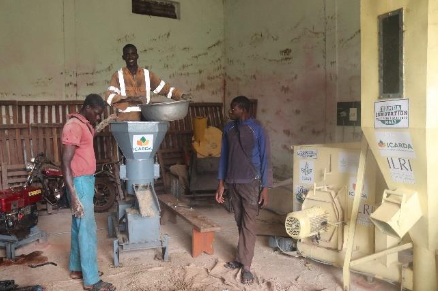
Small-scale Feed Production Using Local Agricultural By-products is an adaptable feed production technology combining locally available agricultural and agro-industrial resources, balanced feed formulations, capacity building, and appropriately selected processing equipment. Feed resources are selected and formulated according to livestock nutritional requirements, then processed through grinding, mixing and, where appropriate, pelletization. Processing systems can range from basic grinder or grinder-mixer configurations to complete grinder-mixer-pelletizer lines, allowing equipment, energy requirements, production capacity, and service models to be adapted to local implementation conditions. This modular approach enables programs to establish feed production systems appropriate to available resources, infrastructure, and producer needs.
2

This technology is pre-validated.

9•8

Scaling readiness: idea maturity 9/9; level of use 8/9

Positive impacts: 16

Target Groups Positive Impacts
Young women smallholder livestock producers in remote areas
  • Reduces feed-related workload: Access to processed, ready-to-use feed can reduce the time and physical effort required for manual feed preparation. 
  • Improves access to affordable feed: Locally produced feed provides an alternative to costly imported concentrates, particularly during seasonal feed shortages. 
  • Creates livelihood opportunities: Decentralized feed production and processing services create opportunities to participate in income-generating activities. 
  • Strengthens resilience: Improved access to locally produced feed helps livestock producers cope with seasonal feed scarcity and declining grazing resources.
Women in resource-poor farmer organizations and cooperatives
  • Strengthens participation in local feed enterprises: Cooperative production and processing models create opportunities for women to participate in feed production, service delivery, and business management. 
  • Builds technical and business capacity: Training and ToT strengthen skills in feed formulation, equipment operation, feed quality management, and business management. 
  • Improves access to processing services: Shared processing units enable members to access grinding, mixing and, where appropriate, pelletizing without individually investing in equipment. 
  • Improves access to balanced feed: Local processing helps cooperatives make better use of available by-products to supply feed during periods of scarcity.
Young members of resource-poor farmer organizations and cooperatives
  • Creates rural employment opportunities: Feed production, equipment operation and maintenance, logistics, and processing services provide potential employment opportunities. 
  • Supports entrepreneurship: Decentralized feed production and service models create opportunities for youth-led enterprises. 
  • Develops technical and business skills: Training builds capacities in feed formulation, equipment operation and maintenance, feed quality management, and business development. 
  • Strengthens local value chains: Youth can participate in feed production, equipment manufacturing and maintenance, ingredient sourcing, and processing services.
Remote smallholder livestock producers
  • Improves feed availability during seasonal shortages: Processing and storing locally available feed ingredients can improve access to livestock feed when grazing resources are limited. 
  • Valorizes local by-products: Agricultural and agro-industrial by-products are converted into nutritionally balanced livestock feed instead of remaining underutilized. 
  • Reduces dependence on costly imported feed: Locally produced feed provides an alternative to imported concentrates and reduces exposure to external feed markets. 
  • Strengthens climate resilience: Greater availability of alternative feed resources can reduce dependence on increasingly constrained grazing lands and strengthen the resilience of livestock production systems.


More...

Climate adaptability: Highly adaptable

Can be adapted to different agroecological contexts by using locally available agricultural and agro-industrial by-products for livestock feed production.

Farmer climate change readiness: Moderate improvement

Helps farmers maintain livestock productivity during feed shortages by converting locally available agricultural by-products into livestock feed.

Biodiversity: Positive impact on biodiversity

Helps reduce pressure on natural grazing lands by providing an alternative livestock feed from locally available by-products.

Carbon footprint: A bit less carbon released

Promotes locally produced livestock feed from agricultural by-products, reducing reliance on imported feed and associated transport emissions.

Environmental health: Moderately improves environmental health

Promotes the productive use of agricultural and agro-industrial by-products through a circular resource-use approach.

Water use: Same amount of water used

The feed processing steps do not significantly change water use compared with existing livestock feed production practices.

Problem

  • Climate-induced feed insecurity: Increasing climate variability is reducing the availability of quality livestock feed, making livestock-dependent communities more vulnerable to production shocks.
  • Limited circular use of agricultural and agro-industrial resources: Nutrient-rich agricultural residues and agro-industrial by-products are often discarded instead of being transformed into valuable livestock feed.
  • Limited access to locally appropriate feed processing solutions: Many smallholder livestock systems lack processing technologies that match local production capacities, available resources, and market demand, limiting sustainable scaling opportunities.
  • Low resilience of livestock production systems: Heavy reliance on imported feed and declining grazing resources reduces the ability of livestock systems to adapt to climate and market shocks.
  • Limited access to scalable, locally adaptable feed production approaches: Many livestock production systems lack integrated approaches that combine local resource use, feed formulation, and appropriate processing technologies to sustainably improve feed availability and livelihoods.

Solution

  • Climate-resilient feed supply: Expands access to locally produced feed during drought and seasonal shortages, strengthening the resilience of livestock-dependent households.
  • Reduced dependence on external feed sources: Builds local feed production capacity using available resources, reducing producers' exposure to costly external feed supplies.
  • Local resource valorization: Transforms underutilized agricultural and agro-industrial by-products into nutritious feed while creating opportunities for local value addition.
  • Adaptable feed production systems: Combines capacity building, feed formulation, and appropriately selected equipment that can be tailored to local resources, infrastructure, energy access, and producer capacity.
  • Reduced pressure on rangelands: Provides alternative feed resources that can reduce dependence on increasingly constrained natural grazing areas.

Key points to design your program

Small-scale Feed Production Using Local Agricultural By-products provides a sustainable and scalable approach to strengthen livestock feed security by transforming locally available agricultural and agro-industrial by-products into nutritionally balanced livestock feed. The technology is highly relevant for livestock development, food security, climate adaptation, circular economy, and rural livelihood programmes, particularly in dryland livestock systems affected by recurrent feed shortages and rangeland degradation. By strengthening local feed production, reducing dependence on imported feed concentrates, and creating rural enterprise opportunities, the technology contributes to SDG 1 (No Poverty), SDG 2 (Zero Hunger), SDG 5 (Gender Equality), SDG 8 (Decent Work and Economic Growth), SDG 12 (Responsible Consumption and Production), and SDG 13 (Climate Action). It also creates opportunities for women and youth to participate in decentralized feed production, processing services, and related enterprises.

To successfully integrate this technology into programmes, plan and budget for:

  • Strategic partnerships: Engage ICARDA, national agricultural research institutions, extension services, farmer organizations, financial institutions, equipment manufacturers, and private-sector partners to support technology adaptation, technical assistance, capacity building, financing, and sustainable equipment supply and maintenance.
  • Target feed-deficit and climate-vulnerable livestock systems: Prioritize livestock-dependent communities affected by recurrent feed shortages, particularly in dryland areas where suitable agricultural and agro-industrial by-products are available for local feed production.
  • Locally adapted feed production systems: Work with ICARDA to assess local conditions and design appropriate production systems, including suitable by-products, balanced feed formulations, processing capacity, equipment configuration, and energy solutions. Systems may range from grinding and mixing units to complete pelletizing lines depending on local needs and operating conditions.
  • Capacity building and knowledge transfer: Establish demonstration activities and implement Training of Trainers (ToT) programmes on feed formulation, equipment operation and maintenance, feed quality management, and business development to build sustainable local technical capacity.
  • Local equipment and technical services: Strengthen the capacity of local manufacturers and suppliers, where appropriate, to adapt and produce suitable feed-processing equipment and provide installation, maintenance, repair, and spare-parts services.
  • Inclusive and sustainable delivery models: Support farmer organizations, cooperatives, and local enterprises to establish viable feed production and feed-processing services, while facilitating access to finance and seasonal procurement and storage of feed ingredients to maintain production during feed-scarcity periods.
  • Monitoring, learning, and scaling: Track technology adoption, feed production volumes and costs, utilization of agricultural and agro-industrial by-products, feed availability, equipment performance, livestock productivity, and participation of women and youth to generate evidence for program improvement, investment decisions, and future scaling.
  • Scale and continuity beyond project funding: Strengthen viable local feed enterprises, producer organizations, trained technical actors, equipment manufacturers, and maintenance networks capable of sustaining and expanding feed production and processing services after program support ends.

Cost vs. revenue

Data reliability of this estimate:: 85 %

Return on investment 9 %

Every USD invested returns USD 0.09 net income.

Detailed financial information ›

IP

Open source / open access

Scaling Readiness describes how complete a technology's development is and its ability to be scaled. It produces a score that measures a technology's readiness along two axes: the level of maturity of the idea itself, and the level to which the technology has been used so far.

Each axis goes from 0 to 9 where 9 is the “ready-to-scale” status. For each technology profile in the e-catalogs we have documented the scaling readiness status from evidence given by the technology providers. The e-catalogs only showcase technologies for which the scaling readiness score is at least 8 for maturity of the idea and 7 for the level of use.

The graph below represents visually the scaling readiness status for this technology, you can see the label of each level by hovering your mouse cursor on the number.

Read more about scaling readiness ›

Scaling readiness score of this technology

Maturity of the idea 9 out of 9

Uncontrolled environment: validated

Level of use 8 out of 9

Used by some intended users, in the real world

Maturity of the idea Level of use
9
8
7
6
5
4
3
2
1
1 2 3 4 5 6 7 8 9

Key recommendations

-

Positive impact 16

Target Groups Positive Impacts
Young women smallholder livestock producers in remote areas
  • Reduces feed-related workload: Access to processed, ready-to-use feed can reduce the time and physical effort required for manual feed preparation. 
  • Improves access to affordable feed: Locally produced feed provides an alternative to costly imported concentrates, particularly during seasonal feed shortages. 
  • Creates livelihood opportunities: Decentralized feed production and processing services create opportunities to participate in income-generating activities. 
  • Strengthens resilience: Improved access to locally produced feed helps livestock producers cope with seasonal feed scarcity and declining grazing resources.
Women in resource-poor farmer organizations and cooperatives
  • Strengthens participation in local feed enterprises: Cooperative production and processing models create opportunities for women to participate in feed production, service delivery, and business management. 
  • Builds technical and business capacity: Training and ToT strengthen skills in feed formulation, equipment operation, feed quality management, and business management. 
  • Improves access to processing services: Shared processing units enable members to access grinding, mixing and, where appropriate, pelletizing without individually investing in equipment. 
  • Improves access to balanced feed: Local processing helps cooperatives make better use of available by-products to supply feed during periods of scarcity.
Young members of resource-poor farmer organizations and cooperatives
  • Creates rural employment opportunities: Feed production, equipment operation and maintenance, logistics, and processing services provide potential employment opportunities. 
  • Supports entrepreneurship: Decentralized feed production and service models create opportunities for youth-led enterprises. 
  • Develops technical and business skills: Training builds capacities in feed formulation, equipment operation and maintenance, feed quality management, and business development. 
  • Strengthens local value chains: Youth can participate in feed production, equipment manufacturing and maintenance, ingredient sourcing, and processing services.
Remote smallholder livestock producers
  • Improves feed availability during seasonal shortages: Processing and storing locally available feed ingredients can improve access to livestock feed when grazing resources are limited. 
  • Valorizes local by-products: Agricultural and agro-industrial by-products are converted into nutritionally balanced livestock feed instead of remaining underutilized. 
  • Reduces dependence on costly imported feed: Locally produced feed provides an alternative to imported concentrates and reduces exposure to external feed markets. 
  • Strengthens climate resilience: Greater availability of alternative feed resources can reduce dependence on increasingly constrained grazing lands and strengthen the resilience of livestock production systems.


Unintended impact 8

Target Groups Potential Unintended Impacts Mitigation Measures
Young women smallholder livestock producers in remote areas
  • Unequal access to the technology: Women and young producers may have less access to feed-processing services, technical training, equipment, or finance, limiting their participation and benefits.
  • Increased workload: Participation in feed production activities could add to existing livestock and household responsibilities if workloads are not considered during implementation.
  • Ensure inclusive access: Prioritize women and youth in beneficiary selection, training, demonstrations, processing services, and appropriate financing mechanisms.
  • Consider workload in implementation: Promote accessible processing services and appropriately scaled equipment, and encourage equitable distribution of production and management responsibilities within households and producer organizations.
Women in resource-poor farmer organizations and cooperatives
  • Unequal participation and benefit sharing: Better-resourced or more influential members may dominate decisions and access to equipment, services, training, or income opportunities. 
  • Limited organizational capacity: Weakly structured farmer organizations may face difficulties managing shared equipment, accessing finance, or operating sustainable feed-processing services.
  • Strengthen inclusive governance: Establish transparent rules for access to equipment and services, benefit sharing, and decision-making, while promoting meaningful participation of women in management and leadership.
  • Strengthen organizational capacity: Support farmer organizations in governance, business management, equipment management, and, where required, formal registration and access to finance.
Young members of resource-poor farmer organizations and cooperatives
  • Limited entrepreneurship opportunities: Young members may participate mainly as equipment operators or laborers without opportunities to develop, manage, or own feed-related enterprises.
  • Business discontinuity: Limited working capital and the seasonal availability of agricultural and agro-industrial by-products may interrupt production and threaten the viability of youth-led businesses.
  • Support youth entrepreneurship: Combine technical training with business planning, financial management, enterprise development, and opportunities to manage feed production or processing services.
  • Plan for seasonal sourcing and finance: Facilitate appropriate financing and storage arrangements that allow enterprises to procure and store suitable by-products when they are available.
Remote smallholder livestock producers
  • Unequal access to processing services: Processing units may be concentrated in more accessible areas or managed by better-resourced groups, leaving remote producers underserved.
  • Infrastructure and technical-service constraints: Unreliable energy supply and limited access to equipment maintenance, spare parts, and technical support may disrupt feed production and reduce long-term use.
  • Promote decentralized and locally adapted services: Locate feed-processing services close to livestock-producing communities and work with ICARDA to select equipment configurations and energy solutions adapted to local conditions.
  • Strengthen local support systems: Build local capacity for equipment operation and maintenance and strengthen access to spare parts, technical assistance, manufacturers, suppliers, and extension services.

Barriers 8

Target Groups Primary Adoption Barriers Actionable Mitigation Measures
Young women smallholder livestock producers in remote areas
  • Financial barrier: Limited access to finance may restrict access to feed-processing equipment or affordable processing services.
  • Capacity barrier: Limited access to technical training, extension services, and practical knowledge can constrain participation in local feed production and processing activities.
  • Improve affordable access: Facilitate appropriate financing for individual or collective investment and promote shared feed-processing services where equipment ownership is not viable.
  • Strengthen local capacity: Provide accessible demonstrations, ToT, and practical training on feed formulation, processing, equipment use, and feed quality management.
Women in resource-poor farmer organizations and cooperatives
  • Organizational barrier: Limited organizational and business capacity can constrain access to finance and the effective management of shared feed-production units and services.
  • Governance barrier: Limited participation of women in decision-making may restrict equitable access to training, equipment, processing services, and business opportunities.
  • Strengthen farmer organizations: Build capacity in governance, business management, equipment management, and financial planning, and support formal registration where required to access finance or public support.
  • Promote inclusive governance: Strengthen women's participation in leadership, technical training, and business management, with transparent rules governing access to equipment, services, and benefits.
Young members of resource-poor farmer organizations and cooperatives
  • Business capacity barrier: Limited entrepreneurial and management skills can constrain the development of viable feed production and processing-service businesses.
  • Seasonal working-capital barrier: Limited finance and storage capacity can restrict procurement of agricultural and agro-industrial by-products when they are seasonally available.
  • Develop technical and entrepreneurial capacity: Combine training in feed formulation and equipment operation with business planning, financial management, and enterprise development.
  • Support seasonal sourcing and finance: Facilitate appropriate credit and storage arrangements to enable procurement and conservation of suitable by-products when available.
Remote smallholder livestock producers
  • Infrastructure barrier: Unreliable energy supply and limited access to appropriate equipment, maintenance, spare parts, and technical support can constrain operation of local feed-production systems.
  • Service-access barrier: Long distances to processing units and technical services may limit adoption by remote livestock producers.
  • Adapt the production system to local conditions: Work with ICARDA to assess local needs and identify suitable equipment configurations, processing capacity, and energy solutions rather than deploying a standardized production line.
  • Develop decentralized support and processing services: Establish locally accessible feed-processing services and strengthen local capacity for equipment operation, maintenance, spare-parts supply, and technical assistance.

Cost of the investment
Sum of all fixed and operational expenses..
USD 44,250
Per ton of feed produced
Gross revenue
Sum of all income before subtracting costs.
USD 48,438
Per ton of feed produced
Net income
Gross revenue minus total cost.
USD 4,188
Per ton of feed produced
Return on investment
Percentage of income earned for each dollar invested, calculated as:
(income ÷ cost of investment) × 100
9 %
year

References:

Countries with a green colour
Tested & adopted
Countries with a bright green colour
Adopted
Countries with a yellow colour
Tested
Countries with a blue colour
Testing ongoing
Egypt Equatorial Guinea Ethiopia Algeria Angola Benin Botswana Burundi Burkina Faso Democratic Republic of the Congo Djibouti Côte d’Ivoire Eritrea Gabon Gambia Ghana Guinea Guinea-Bissau Cameroon Kenya Libya Liberia Madagascar Mali Malawi Morocco Mauritania Mozambique Namibia Niger Nigeria Republic of the Congo Rwanda Zambia Senegal Sierra Leone Zimbabwe Somalia South Sudan Sudan South Africa Eswatini Tanzania Togo Tunisia Chad Uganda Western Sahara Central African Republic Lesotho
Countries where the technology is being tested or has been tested and adopted
Country Testing ongoing Tested Adopted
Ethiopia No ongoing testing Tested Adopted
Mali No ongoing testing Tested Adopted
Tunisia No ongoing testing Tested Adopted

This technology can be used in the colored agro-ecological zones. Any zones shown in white are not suitable for this technology.
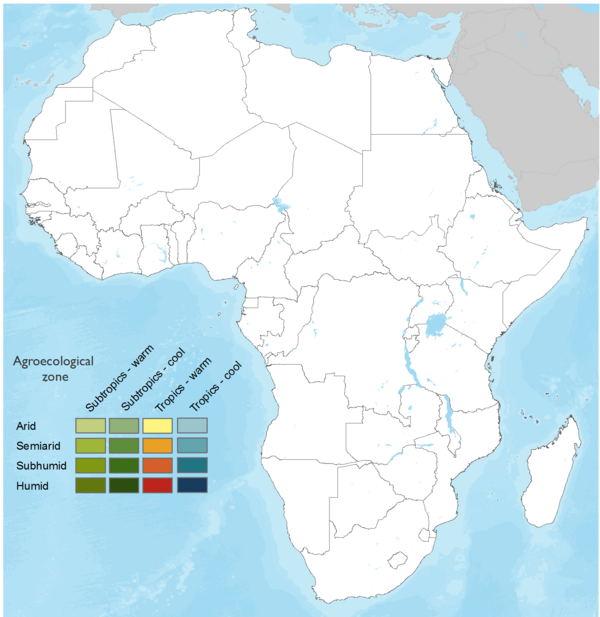
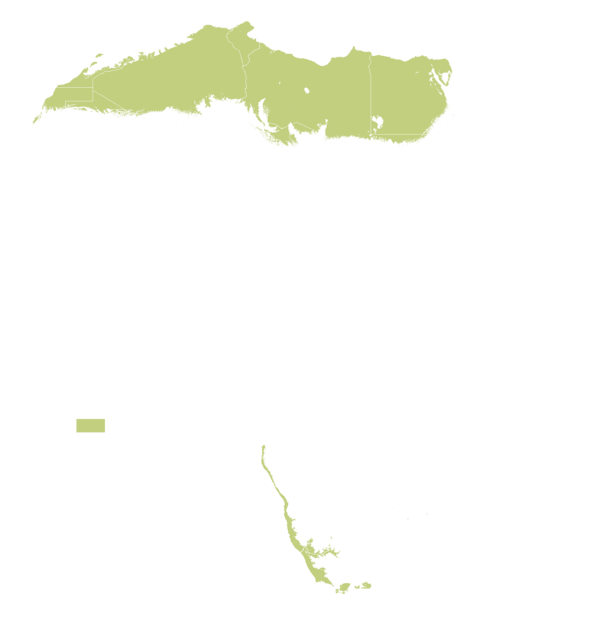
Agro-ecological zones where this technology can be used
AEZ Subtropic - warm Subtropic - cool Tropic - warm Tropic - cool
Arid
Semiarid
Subhumid
Humid

Source: HarvestChoice/IFPRI 2009

The United Nations Sustainable Development Goals that are applicable to this technology.
Sustainable Development Goal 1: no poverty
Goal 1: no poverty

Reduces livestock feeding costs, improves livestock productivity, and increases farmers' income through locally produced feed.
Sustainable Development Goal 2: zero hunger
Goal 2: zero hunger

Strengthens year-round livestock feed availability, improving livestock productivity and contributing to food security.
Sustainable Development Goal 5: gender equality
Goal 5: gender equality

Reduces the time and physical labour traditionally associated with animal feeding, creating opportunities for women to engage in other productive activities.
Sustainable Development Goal 8: decent work and economic growth
Goal 8: decent work and economic growth

Creates business and employment opportunities through feed processing, equipment manufacturing, and feed pelleting services.
Sustainable Development Goal 12: responsible production and consumption
Goal 12: responsible production and consumption

Promotes the productive use of agricultural and agro-industrial by-products through circular resource use and local feed production.
Sustainable Development Goal 15: life on land
Goal 15: life on land

Strengthens livestock resilience to drought by providing locally produced feed from agricultural and agro-industrial by-products.

The technology is implemented by first identifying suitable local by-products and developing balanced feed formulations, then designing a small-scale processing unit adapted to local production needs, infrastructure, energy availability, and business conditions.

Step 1 – Identify locally available by-products: Identify suitable agricultural and agro-industrial by-products and assess their availability, seasonality, nutritional value, and cost.

Step 2 – Develop balanced feed formulations: Combine selected by-products with other necessary feed ingredients according to livestock nutritional requirements and locally available resources.

Step 3 – Design the appropriate processing unit: Select the type, capacity, and combination of equipment according to local conditions. Depending on production needs, infrastructure, energy availability, and investment capacity, the unit may include a grinder, mixer, pelletizer, or a simpler equipment configuration.

Step 4 – Build technical and business capacity: Train operators and farmer organizations in feed formulation, equipment operation and maintenance, feed quality management, and business management.

Step 5 – Produce and store the feed: Grind and mix the formulated ingredients and, where appropriate, pelletize the feed. Store the processed feed under suitable conditions to maintain its quality and availability.

Step 6 – Establish the production or service model: Use the unit for feed production and sale or provide feed-processing services to farmers and cooperative members.

Step 7 – Monitor and adapt operations: Monitor feed quality, production costs, equipment performance, ingredient availability, energy supply, and market demand, and adjust the formulation or processing system as needed.

Last updated on Sep 16, 2026