TAAT e-catalog
for
Development partners
https://e-catalogs.taat-africa.org/org/technologies/farmbetter-3-in-1-digital-advisory-platform
Smart farming support—anytime, anywhere.
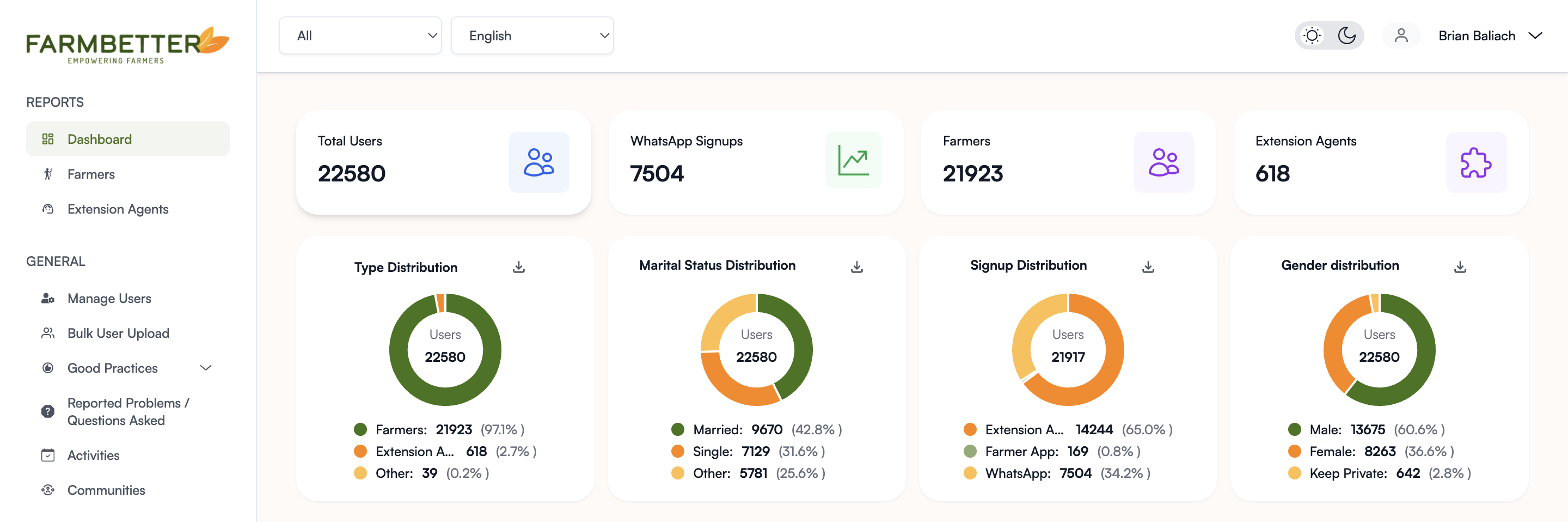
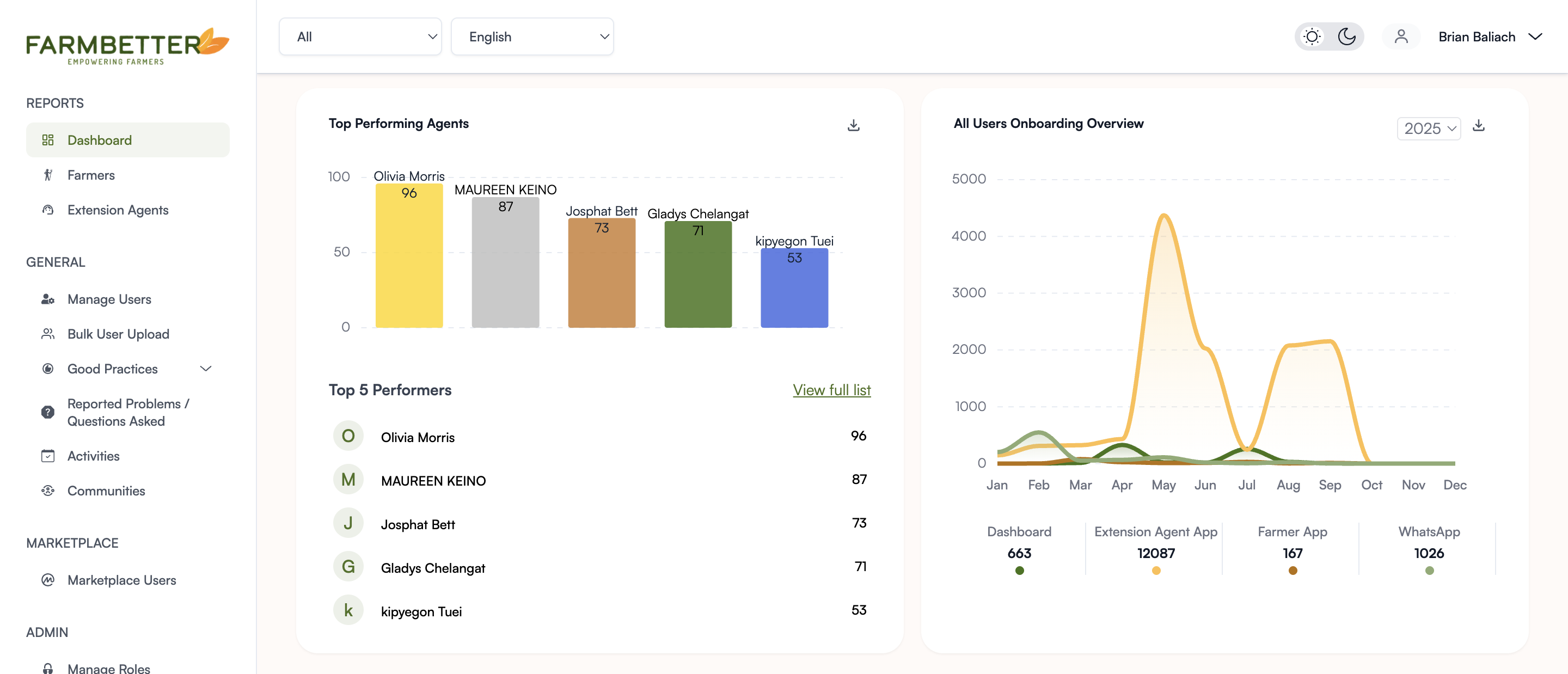
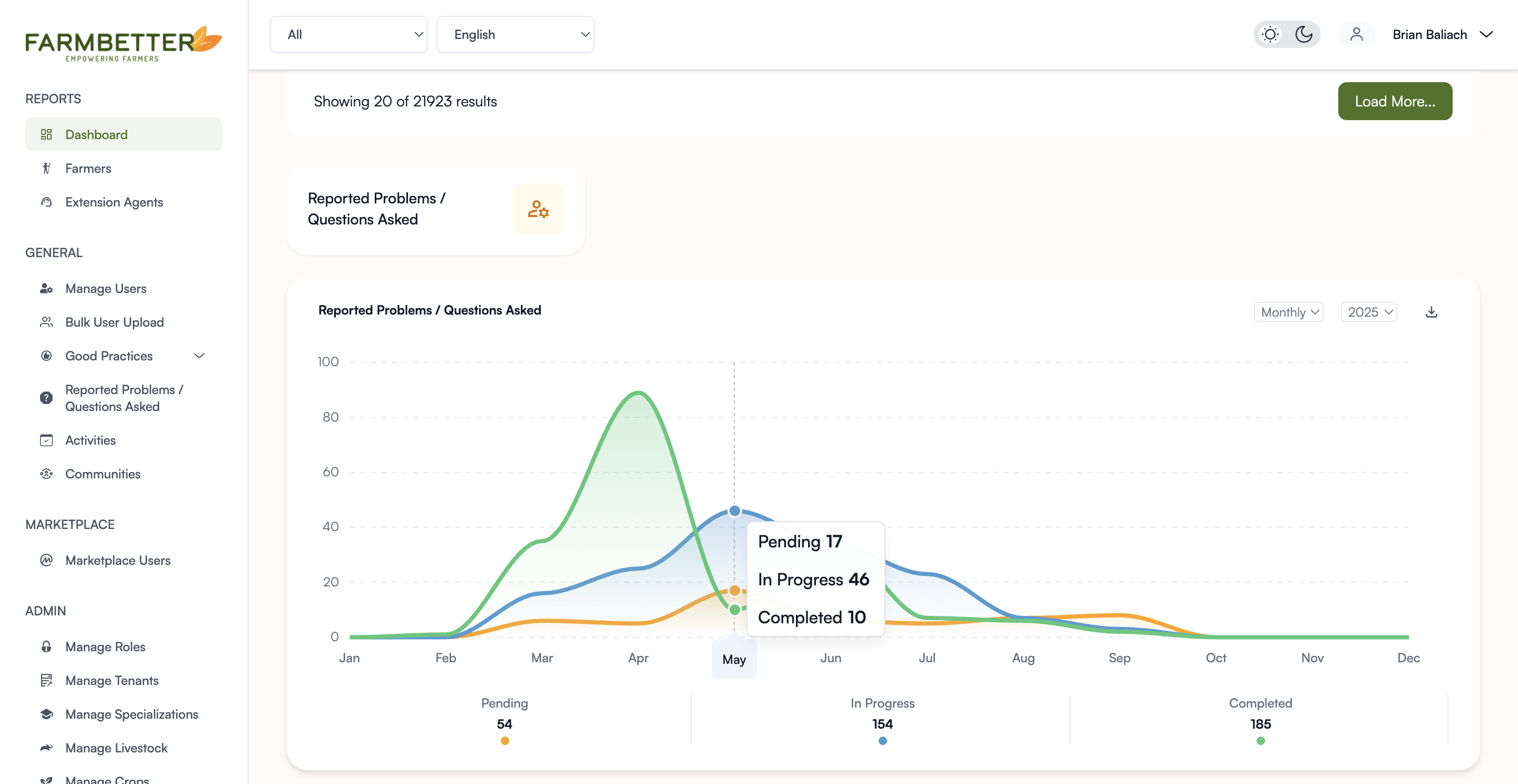
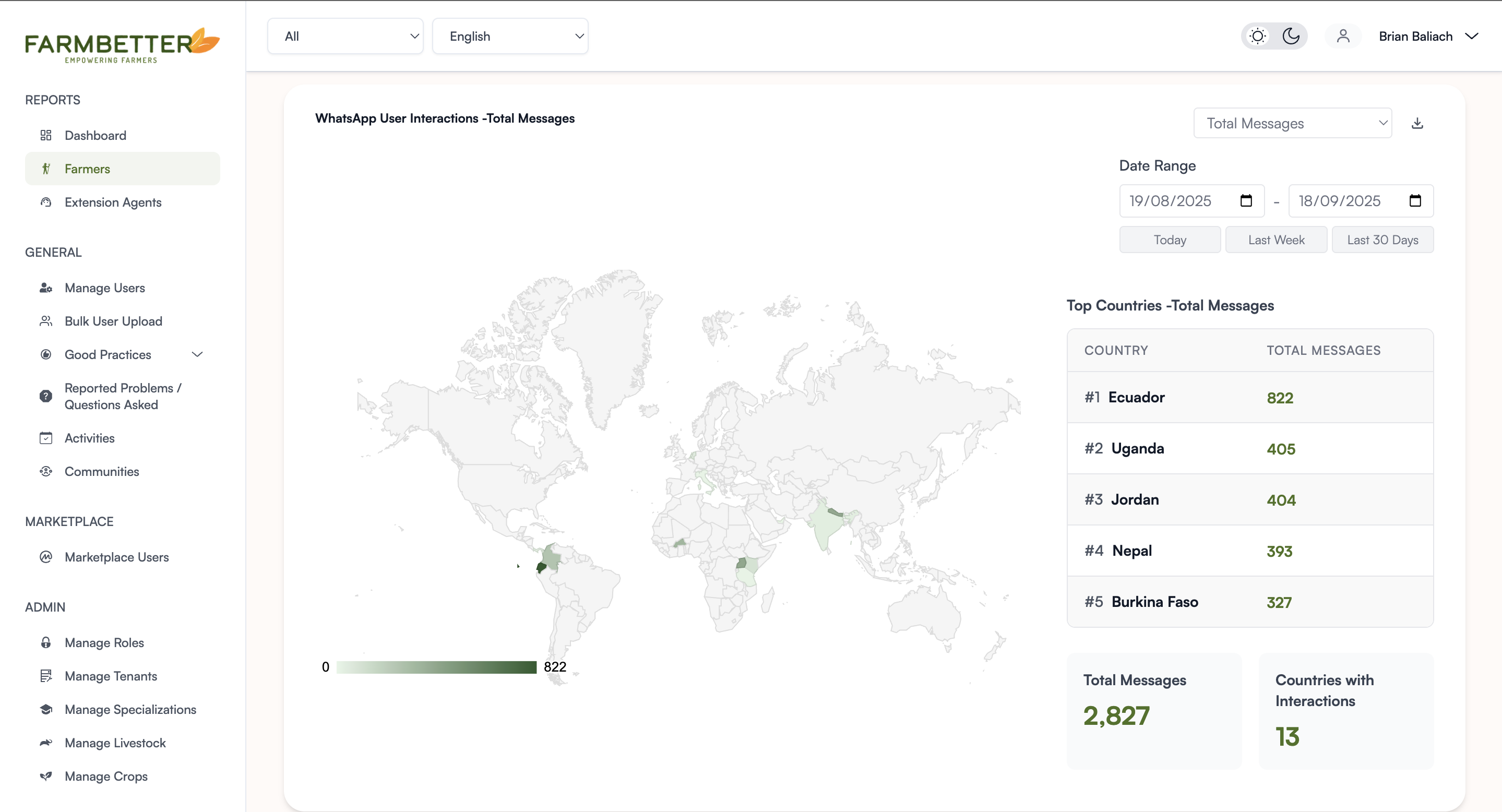
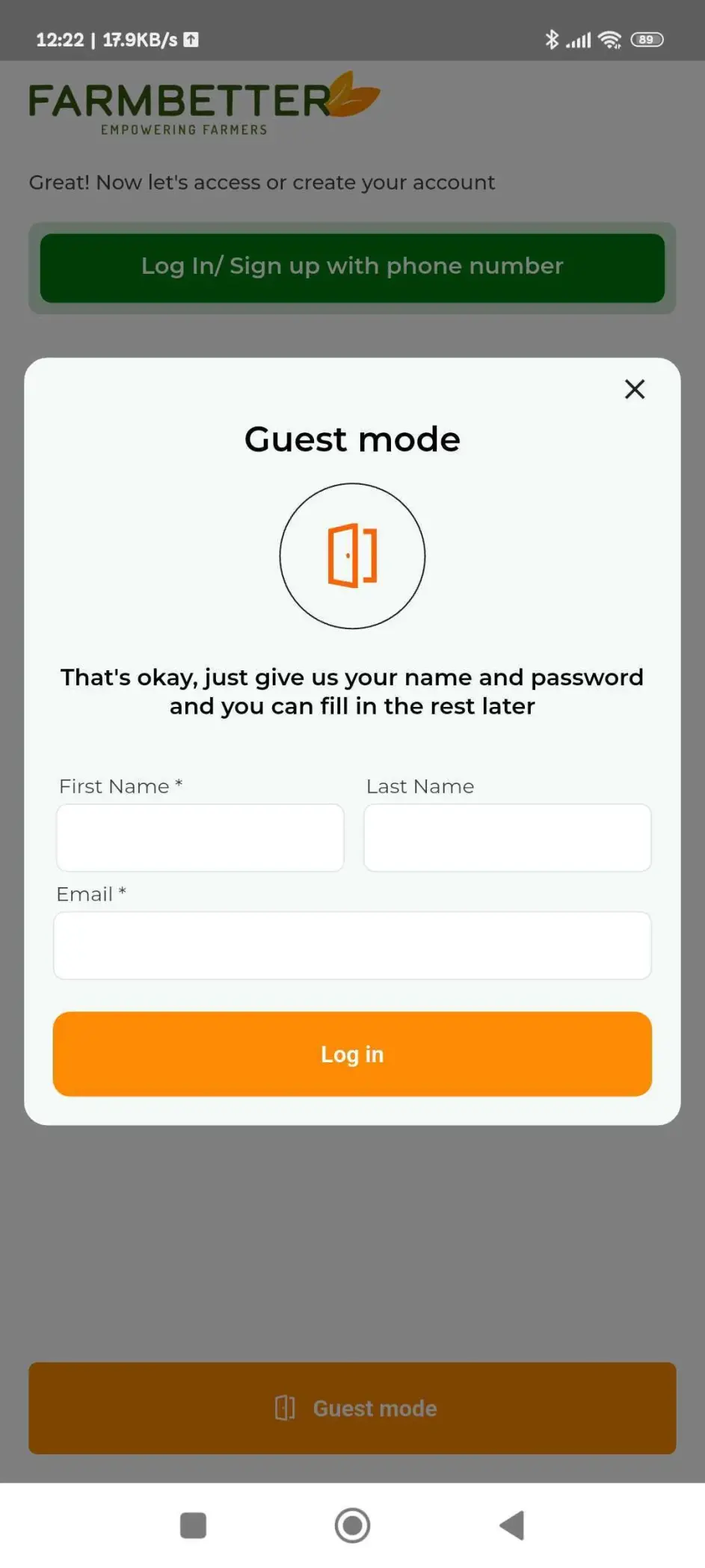
farmbetter is a proven digital solution that enables development programs to deliver climate-smart advisory services at scale—while tracking adoption, inclusion, and impact. Farmers receive personalized guidance via a WhatsApp chatbot, tailored to their location, crops, and soil conditions. Field agents use a mobile app to register farmers, provide follow-up, and monitor behavior change. Project teams access a live dashboard showing real-time adoption data, gender and youth reach, and field activities.
This system reduces delivery costs, shortens feedback loops, and simplifies M&E. Already active in 9 countries, farmbetter is used in donor-funded programs (e.g., SDC, GIZ, SWISSAID) and is built to align with logframes, gender targets, and climate resilience outcomes. Partners fund the license and training, while the platform ensures quality, consistency, and results across diverse regions.
This technology is pre-validated.
Adults 18 and over: Positive high
Adult farmers, regardless of education level or farm size, gain timely and relevant agronomic advice. This helps smallholder men and women in both rural and peri-urban areas increase productivity, improve income stability, and reduce vulnerability to seasonal shocks.
Others: Positive high
Farmers in geographically isolated areas gain timely agronomic guidance without needing to travel to extension offices. This reduces information gaps between rural and urban farmers and strengthens local food production systems. The platform can be adapted to provide information in simple language or local languages, and through formats that reduce dependence on high literacy, ensuring inclusion of users who may otherwise be excluded from written technical materials.
The poor: Positive high
Farmers with limited financial capacity benefit from low-cost, accessible advisory services that optimize input use, reduce production risks, and improve return on investment. The impact is particularly significant in remote areas where access to formal extension or markets is limited.
Under 18: Positive high
Children and youth benefit indirectly when their households adopt improved farming practices. Better yields and income improve access to nutritious food, school attendance, and educational performance. The effect is strongest for rural youth from low-income households where farming is the primary livelihood.
Women: Positive high
Women farmers—often managing smaller plots or engaging in home gardens—gain equal access to quality agricultural information. The technology addresses barriers such as limited mobility, lower access to extension services, and fewer financial resources, enabling women to improve yields, income, and household food security.
Climate adaptability: Highly adaptable
The platform provides climate-smart recommendations tailored to local agroecological zones, benefiting farmers in diverse settings—from drought-prone rural areas to high-rainfall zones—regardless of farm size or resource level.
Farmer climate change readiness: Significant improvement
Advisory services improve readiness for climate shocks by offering location-specific, seasonal guidance. The benefits are greatest for smallholders in vulnerable regions with limited access to formal climate information systems.
Biodiversity: Positive impact on biodiversity
Promotes diversified cropping systems and integrated pest management. The impact is stronger in mixed-farming households where biodiversity also supports nutrition and resilience.
Environmental health: Greatly improves environmental health
Promotes safe and efficient input use, reducing chemical runoff and soil degradation. This benefits farmers in both high-density peri-urban zones (reducing water contamination) and rural catchment areas.
Soil quality: Improves soil health and fertility
Encourages organic matter restoration, crop rotation, and reduced tillage. These practices are especially impactful for small-scale farmers on degraded soils with limited access to synthetic fertilizers.
Water use: Much less water used
Disseminates water-saving irrigation and moisture-retention practices. The benefits are particularly significant for farmers in water-scarce zones and for women who often bear responsibility for water collection and management.
High cost of advisory delivery: Development programmes can require substantial resources to provide face-to-face training and field support across multiple locations.
Limited evidence of adoption: Programme teams may know that advice was delivered but lack reliable data on whether farmers applied the recommended practices.
Slow monitoring and reporting: Manual data collection and disconnected reporting systems can delay programme reviews and performance assessments.
Difficulty measuring inclusion: Monitoring whether women, young people, and underserved communities receive and use advisory services can be challenging.
Weak feedback mechanisms: Programme teams may not receive timely information about farmers' challenges, engagement, or need for additional support.
Challenges demonstrating results: Inconsistent records can make it harder to document programme reach, behaviour change, and progress towards productivity and climate-resilience objectives.
More cost-efficient advisory delivery: The platform combines WhatsApp-based advice and digital extension tools to help programmes reach farmers without relying exclusively on in-person activities.
Better tracking of adoption: Digital records enable programme teams to monitor farmer engagement and the application of recommended agricultural practices.
Streamlined monitoring and reporting: The dashboard consolidates information on farmer reach, extension activities, and adoption to support programme monitoring and evaluation.
Improved inclusion assessment: Gender and age indicators can help development partners assess the reach of their advisory services among different beneficiary groups.
Faster feedback and adaptation: Digital monitoring and farmer feedback can help programme teams identify gaps, refine advisory content, and adjust delivery approaches.
Stronger performance evidence: Consolidated information on service delivery and practice adoption can support evidence-based assessments of programme progress and implementation effectiveness.
Farmbetter enables development partners to deliver climate-smart agricultural advice at scale, reach underserved farmers, and track project impact through real-time data. It is ideal for integrating into funded programs to enhance farmer knowledge, build extension capacity, and provide measurable results aligned with SDGs.
Key Points to Integrate farmbetter into Development Projects
Every USD invested returns USD 2.42 net income.
Provisional application, Copyright, Trademark
Scaling Readiness describes how complete a technology's development is and its ability to be scaled. It produces a score that measures a technology's readiness along two axes: the level of maturity of the idea itself, and the level to which the technology has been used so far.
Each axis goes from 0 to 9 where 9 is the “ready-to-scale” status. For each technology profile in the e-catalogs we have documented the scaling readiness status from evidence given by the technology providers. The e-catalogs only showcase technologies for which the scaling readiness score is at least 8 for maturity of the idea and 7 for the level of use.
The graph below represents visually the scaling readiness status for this technology, you can see the label of each level by hovering your mouse cursor on the number.
Read more about scaling readiness ›
Uncontrolled environment: validated
Used by some intended users, in the real world
| Maturity of the idea | Level of use | |||||||||
| 9 | ||||||||||
| 8 | ||||||||||
| 7 | ||||||||||
| 6 | ||||||||||
| 5 | ||||||||||
| 4 | ||||||||||
| 3 | ||||||||||
| 2 | ||||||||||
| 1 | ||||||||||
| 1 | 2 | 3 | 4 | 5 | 6 | 7 | 8 | 9 | ||
|
Cost of the investment Sum of all fixed and operational expenses.. |
USD 8,830 per year per organisation |
|---|---|
|
Gross revenue Sum of all income before subtracting costs. |
USD 21,383 per year per organisation |
|
Net income Gross revenue minus total cost. |
USD 12,553 per year per organisation |
|
Return on investment Percentage of income earned for each dollar invested, calculated as: (income ÷ cost of investment) × 100 |
242 % per year per organisation |
| Country | Testing ongoing | Tested | Adopted |
|---|---|---|---|
| Kenya | –No ongoing testing | –Not tested | Adopted |
| Tanzania | –No ongoing testing | –Not tested | Adopted |
| Uganda | –No ongoing testing | –Not tested | Adopted |
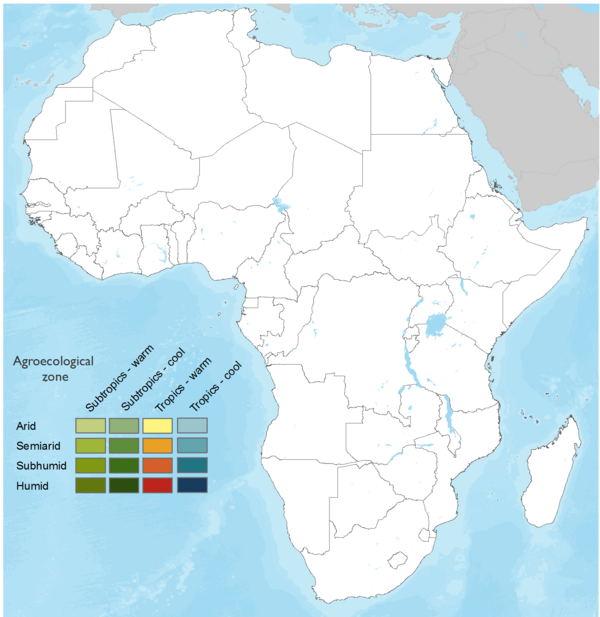
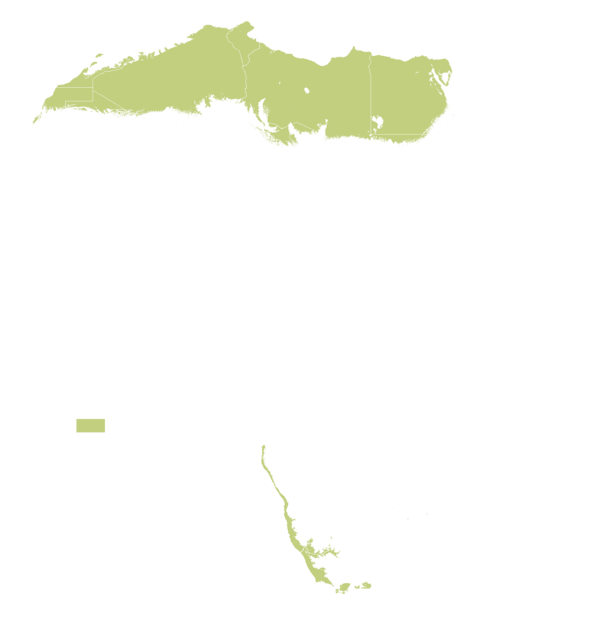
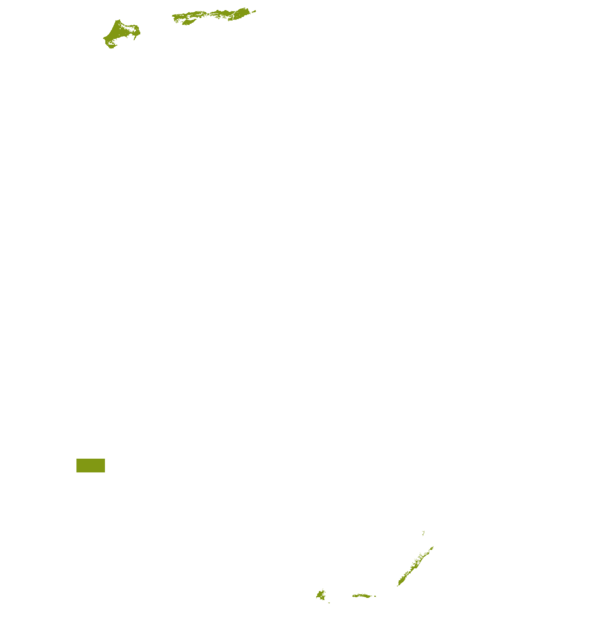
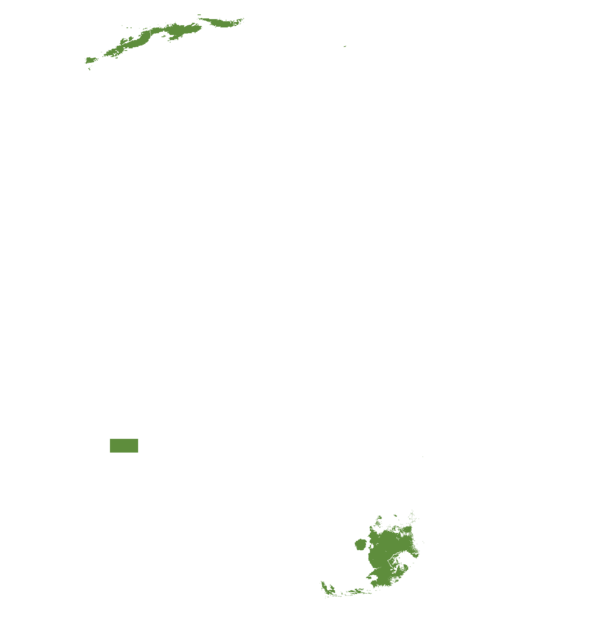
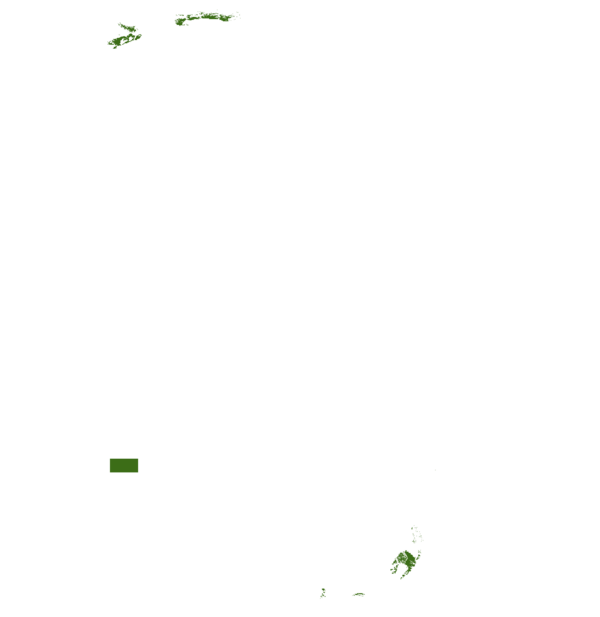
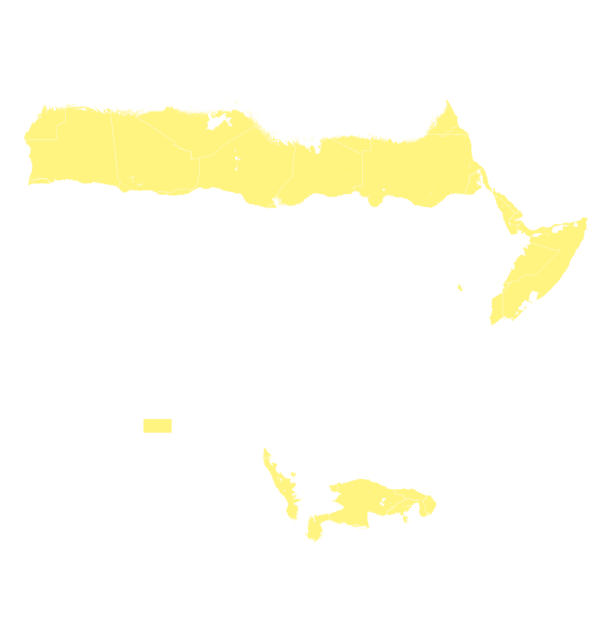
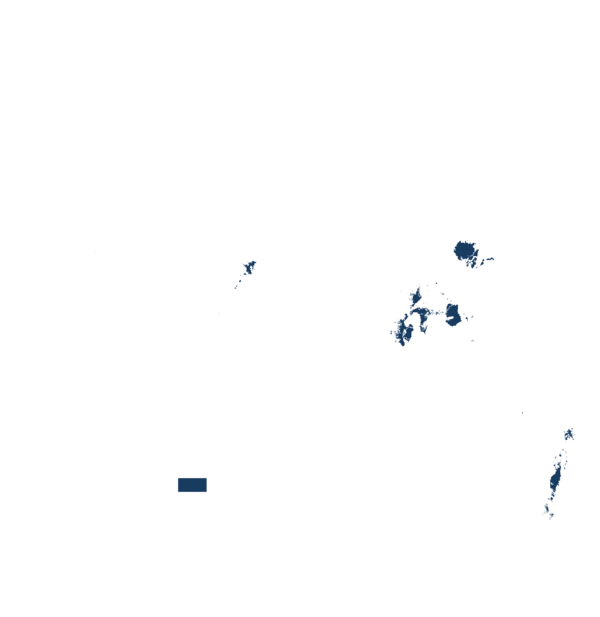
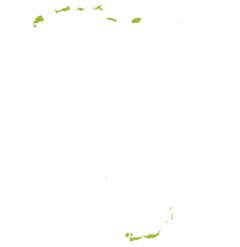
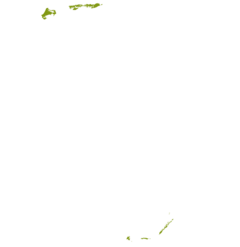
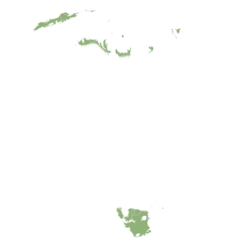
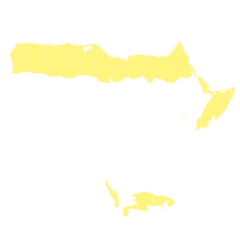
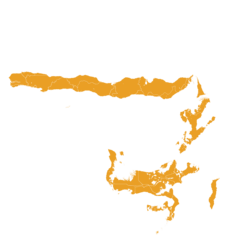
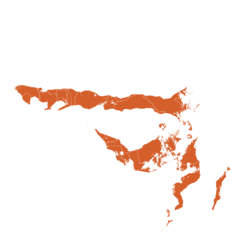
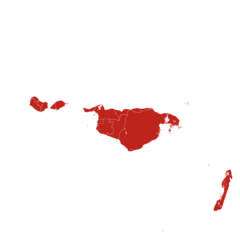
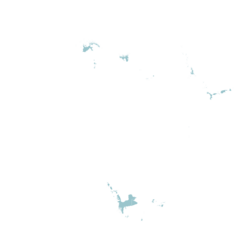
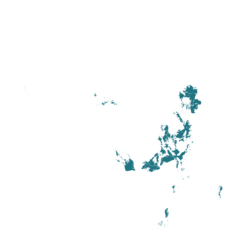
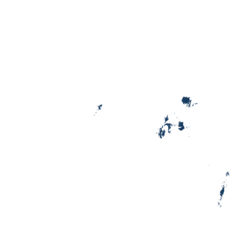
This technology can be used in the colored agro-ecological zones. Any zones shown in white are not suitable for this technology.



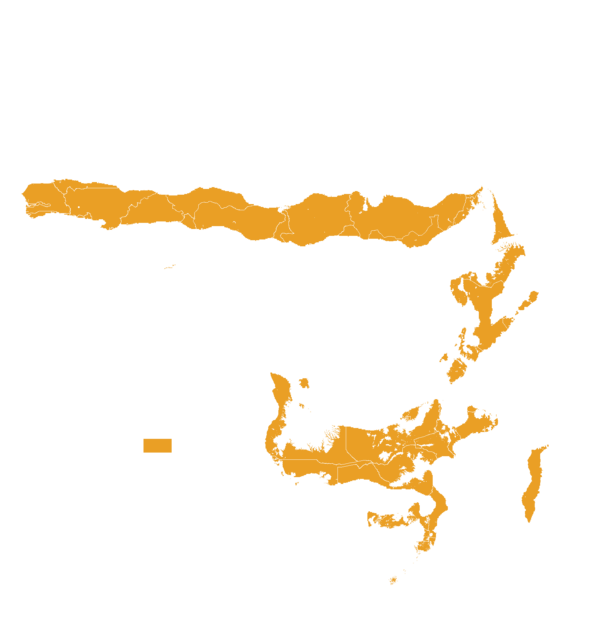
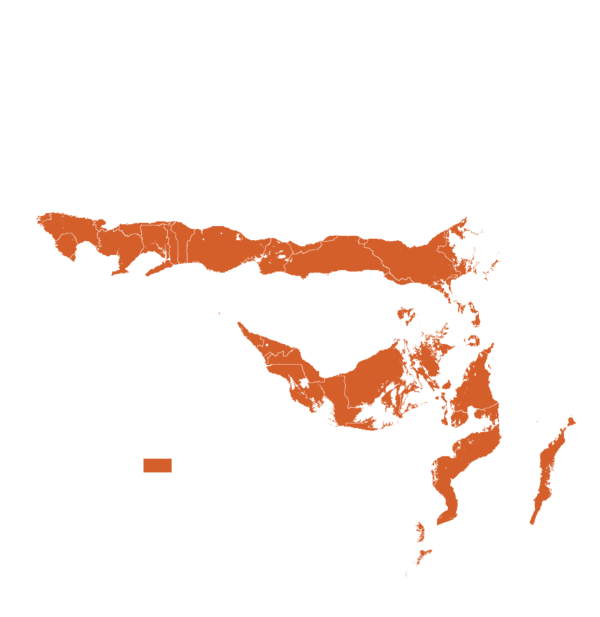

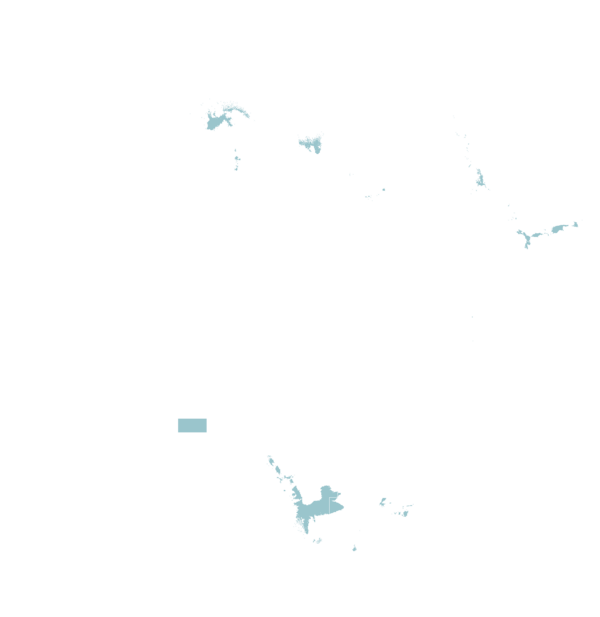

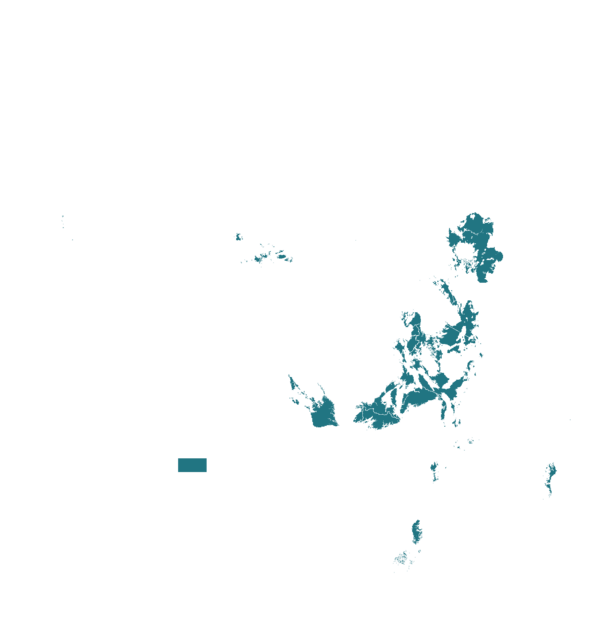
| AEZ | Subtropic - warm | Subtropic - cool | Tropic - warm | Tropic - cool |
|---|---|---|---|---|
| Arid | ||||
| Semiarid | ||||
| Subhumid | ||||
| Humid |
Source: HarvestChoice/IFPRI 2009
The United Nations Sustainable Development Goals that are applicable to this technology.
Increases farm profitability through better yields and reduced input waste, raising household incomes for smallholder farmers.
Improves food availability and stability by enabling farmers to produce more and better-quality crops.
Promotes the production of diverse, nutritious foods and reduces harmful chemical exposure through safe input-use recommendations.
Ensures women farmers have equal access to agronomic knowledge, improving their decision-making power and income potential.
Strengthens rural economies by increasing agricultural productivity and creating opportunities for value chain engagement.
Encourages resource-efficient farming practices, reducing waste and improving input-use efficiency.
Disseminates climate-smart agricultural practices that improve resilience to climate variability and reduce vulnerability to extreme events.
Promotes biodiversity-friendly practices, soil conservation, and sustainable land management.
Organizations contact FarmBetter Ltd. to purchase a SaaS license tailored to the number of farmers or agents they plan to support (e.g., cooperatives, NGOs, governments). The setup includes negotiation for language customization and content localization.
The system is configured using over 1,700 peer-reviewed sustainable agriculture practices from databases like WOCAT. Content is translated and adapted to local languages, crops, soils, and climate zones.
A Training‑of‑Trainers session is conducted where master trainers, extension agents, or cooperative staff are taught to use the mobile app and WhatsApp chatbot, and register farmers. Trained agents then roll out training to local staff.
Farmers either self-register or are registered by agents via WhatsApp. The chatbot prompts a short survey on farm location, crops, goals, and challenges, then delivers customized advice tailored to the farm situation.
Agents use the farmbetter Android app to manage farmer profiles, track adoption of recommended practices, plan follow-ups, and sync data when internet is available—also works offline.
Project managers and organizations access a web-based dashboard to track farmer engagement, practice adoption, agent activity, and inclusion metrics such as gender or age. This supports data-driven decision-making and M&E reporting.
Implementation partners review dashboard data and farmer feedback to refine content, adapt language or delivery mode, and expand reach. Advanced features like AI-based chatbot automation are gradually introduced.
License renewals and refresher training ensure continuity. Updated practices and features (including offline support and voice messages) are pushed periodically to all users to maintain relevance.
Last updated on Oct 15, 2026
This technology can be used in the colored agro-ecological zones.








Farmbetter: 3-in-1 Digital Advisory Platform
https://e-catalogs.taat-africa.org/org/technologies/farmbetter-3-in-1-digital-advisory-platform
Last updated on 15 October 2026, printed on Oct 18, 2026
Enquiries e-catalogs@taat.africa