
TAAT e-catalog
for
private sector
https://e-catalogs.taat-africa.org/com/technologies/zainer-low-cost-zai-field-preparation
The Fast Track to Climate-Smart Farming
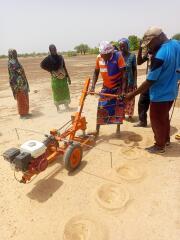
Zainer is a practical mechanization solution that enables service providers, cooperatives, and farmers to efficiently establish Zai planting holes for rainwater harvesting. The machine drills holes approximately 25 cm deep in about 4 seconds and produces up to 17 pits per minute, reducing labor requirements from 300 hours to 40 hours per hectare. Its low operating requirements, local repairability, and estimated lifespan of about five years support cost effective service delivery and business opportunities in dryland agriculture.
This technology is pre-validated.
Every USD invested returns USD 0.13 net income.
No formal IP rights
Zainer helps farmers, cooperatives, and mechanization service providers improve the efficiency of Zai pit establishment, reducing land preparation requirements from approximately 300 hours to 40 hours per hectare.
To integrate this technology into your business model, plan and budget for the following activities and prerequisites:
| Target Group | Positive Impacts |
|---|---|
| Women smallholder farmers in degraded dryland areas |
|
| Youth farmers in rural or marginalized regions |
|
| Women-headed households with climate-vulnerable farms |
|
| Agricultural cooperatives and producer organizations |
|
| Rural service providers and agripreneurs |
|
| NGOs and land restoration projects |
|
| Agricultural extension agents and technical services |
|
| Rural communities in highly degraded areas |
|
Climate adaptability: Highly adaptable
The technology enables the resilience of the rainfed system and adaptation to climate change impacts.
Farmer climate change readiness: Significant improvement
Enables in-situ water harvesting that improves soil moisture and water infiltration in dry environment
Biodiversity: Positive impact on biodiversity
Water use: More water used
The technology enabled water harvesting to make more water available in dry season
Scaling Readiness describes how complete a technology's development is and its ability to be scaled. It produces a score that measures a technology's readiness along two axes: the level of maturity of the idea itself, and the level to which the technology has been used so far.
Each axis goes from 0 to 9 where 9 is the “ready-to-scale” status. For each technology profile in the e-catalogs we have documented the scaling readiness status from evidence given by the technology providers. The e-catalogs only showcase technologies for which the scaling readiness score is at least 8 for maturity of the idea and 7 for the level of use.
The graph below represents visually the scaling readiness status for this technology, you can see the label of each level by hovering your mouse cursor on the number.
Read more about scaling readiness ›
Uncontrolled environment: validated
Common use by intended users, in the real world
| Maturity of the idea | Level of use | |||||||||
| 9 | ||||||||||
| 8 | ||||||||||
| 7 | ||||||||||
| 6 | ||||||||||
| 5 | ||||||||||
| 4 | ||||||||||
| 3 | ||||||||||
| 2 | ||||||||||
| 1 | ||||||||||
| 1 | 2 | 3 | 4 | 5 | 6 | 7 | 8 | 9 | ||
| Project | Countries | Beneficiaries | Budget (USD) & duration | Key figures |
|---|---|---|---|---|
|
Agro-Industrial Zones Promotion of Sustainable Agricultural Value Chains in Special Agro-Industrial Processing Zones Program |
|
|
285.38 million 2024–2029 |
|
|
EFPP(AEFPF) Emergency Food Production Project (AEFPF) |
|
|
25.5 million 2022–2026 |
|
|
SSEFPP-1 SSEFPP-1 Emergency Food Production Plan |
|
|
8.1 million 2022–2023 |
|
Figures in italic are from project plans and may change during implementation.
| Target Group | Positive Impacts |
|---|---|
| Women smallholder farmers in degraded dryland areas |
|
| Youth farmers in rural or marginalized regions |
|
| Women-headed households with climate-vulnerable farms |
|
| Agricultural cooperatives and producer organizations |
|
| Rural service providers and agripreneurs |
|
| NGOs and land restoration projects |
|
| Agricultural extension agents and technical services |
|
| Rural communities in highly degraded areas |
|
| Target Group | Unintended Impacts | Mitigation Measures |
|---|---|---|
| Women smallholder farmers in degraded dryland areas |
|
|
| Youth farmers in rural or marginalized regions |
|
|
| Women-headed households with climate-vulnerable farms |
|
|
| Agricultural cooperatives and producer groups |
|
|
| Rural service providers and agripreneurs |
|
|
| NGOs and land restoration programs |
|
|
| Agricultural extension agents |
|
|
| Rural communities in highly degraded areas |
|
|
| Target Group | Barriers | Mitigation Measures |
|---|---|---|
| Women smallholder farmers in degraded dryland areas |
|
|
| Youth farmers in rural or marginalized regions |
|
|
| Women-headed households with climate-vulnerable farms |
|
|
| Agricultural cooperatives and producer groups |
|
|
| Rural service providers and agripreneurs |
|
|
| NGOs and land restoration programs |
|
|
| Agricultural extension agents |
|
|
| Rural communities in highly degraded areas |
|
|
|
Cost of the investment Sum of all fixed and operational expenses.. |
USD 1,600 per hectare |
|---|---|
|
Gross revenue Sum of all income before subtracting costs. |
USD 1,800 per hectare |
|
Net income Gross revenue minus total cost. |
USD 200 per hectare |
|
Return on investment Percentage of income earned for each dollar invested, calculated as: (income ÷ cost of investment) × 100 |
13 % per hectare |
| Country | Testing ongoing | Tested | Adopted | |
|---|---|---|---|---|
| This technology has not been tested or adopted in any country. | ||||
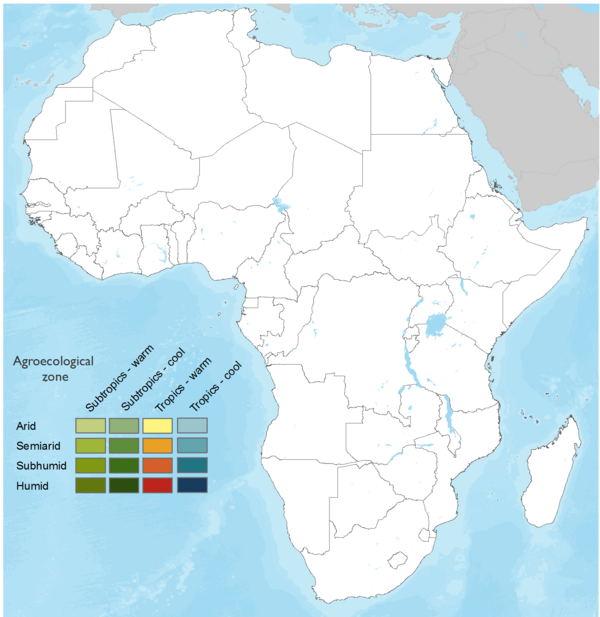
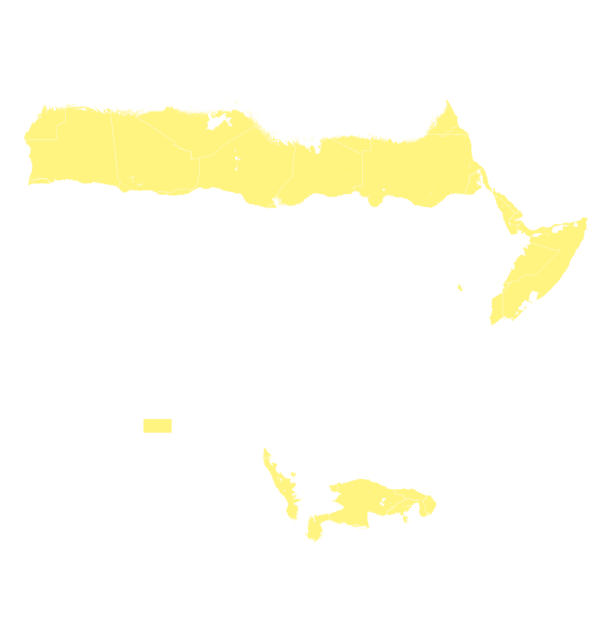
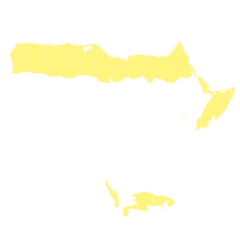
This technology can be used in the colored agro-ecological zones. Any zones shown in white are not suitable for this technology.


| AEZ | Subtropic - warm | Subtropic - cool | Tropic - warm | Tropic - cool |
|---|---|---|---|---|
| Arid | – | – | – | |
| Semiarid | – | – | – | |
| Subhumid | – | – | – | |
| Humid | – | – | – | – |
Source: HarvestChoice/IFPRI 2009
The United Nations Sustainable Development Goals that are applicable to this technology.
This technology supports food security and sustainable agriculture goals.
Position at the Field
Move the Zainer to the field and place it at the starting point according to the crop spacing (e.g., 25–30 cm between Zai pits).
Operate the Drill
Start the engine and press the drill bit into the soil to the desired depth (25 cm). Move to the next planting point and repeat until the field is complete.
Monitor and Adjust
Ensure consistent pit depth and spacing while drilling. Adjust engine speed or operator technique if necessary for uniform holes.
Clean and Maintain
After completing field operations, remove dirt and moisture from the machine. Oil the drill bit and other moving metal parts to prevent rust. Perform regular maintenance for long-term operation.
Last updated on Oct 1, 2026
This technology can be used in the colored agro-ecological zones.




Zainer: Low-cost Zai field preparation
https://e-catalogs.taat-africa.org/com/technologies/zainer-low-cost-zai-field-preparation
Last updated on 1 October 2026, printed on Oct 10, 2026
Enquiries e-catalogs@taat.africa
