Dry Out the Methane. Green Up Your Harvest.
Alternate Wetting and Drying is an intermittent irrigation method for lowland rice that alternates short dry periods with shallow re-flooding. It works by monitoring the water level below the soil surface and irrigating only when a safe threshold is reached. This cuts water and energy use—often by about 15–30%—while keeping yields stable, lowering pumping costs, and enabling companies to document methane reductions, a major greenhouse gas from flooded rice.
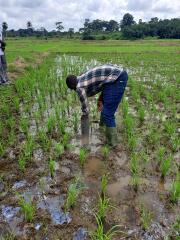
This technology is validated.
Every USD invested returns USD 0.42 net income.
Cost per hectare
Revenue per hectare
Net income per hectare
ROI per season/per hectare
Water use reduction
Greenhouse Gas Emissions Reductions
Open source / open access
High irrigation and energy costs: Continuous flooding uses more water and pump hours than needed, thereby raising diesel/electricity bills.
Water scarcity disrupting supply and contracts: Limited or unreliable water constrains planted area and harvest schedules.
Methane emissions from flooded paddies: Prolonged anaerobic conditions drive methane, increasing climate risk and compliance pressure.
Low water productivity across estates/outgrowers: Too much water per ton of rice compared with best practice.
Weak sustainability evidence: Many operations lack simple, field-level measures to show water savings and emission cuts.
The implementation of Alternate Wetting and Drying (AWD) provides a compelling return on investment (ROI) by optimizing resource use and enhancing the sustainability profile of rice production.
The primary groups targeted for applying and benefiting from this practice include:
Successful adoption of AWD at a business scale requires investing in the following resources:
Collaboration across sectors is essential for scaling AWD effectively:
The cost-benefit profile of AWD is highly favorable, characterized by negligible capital costs and high operating savings.
| Cost/Financial Element | Description & Value |
| Upfront Investment Cost | Minimal to zero. The cost is primarily the field water tube, estimated at $5 or less per field, or made from recycled materials. |
| Recurring Operating Cost | Mainly composed of staff time for monitoring the water tube (which is minimal) and the cost of training (often borne by development agencies). |
| Primary Savings (Reduced Costs) | 15–30% reduction in irrigation water use, leading to substantial savings on fuel or electricity for pumping. |
| Revenue/Profit Impact | Yields are maintained or slightly improved. Net profit increases due to lower input costs. Potential new revenue from carbon credit sales. |
Before committing to large-scale AWD adoption, businesses should evaluate the following technical and operational considerations:
| Target groups | Positive impacts |
| Women rice farmers & female-headed households | Benefit from reduced irrigation labor and more predictable schedules, easing time pressure and helping manage household and farm duties simultaneously. |
| Downstream (tail-end) canal-irrigated farmers | Gain more reliable water access when AWD reduces upstream overuse, leading to more equitable irrigation and stable yields. |
| Pump-irrigated smallholders (men & women) | Save fuel and labor as AWD reduces water use and pump runtime by 20–30%, directly lowering production costs. |
| Climate-conscious or sustainability-focused rice growers | Reduce methane emissions (up to 50%) and qualify for carbon credits or green certification schemes, potentially increasing income and market access. |
| Farmers in drought-prone or water-scarce areas | Maintain yields using 20–40% less water, helping them adapt to water shortages and reduce dependency on unreliable rainfall or depleted water tables. |
Climate adaptability: Highly adaptable
AWD promotes efficient water use by reducing irrigation needs by 25–40%. In irrigation schemes, this enables more farmers to access water or to cultivate larger areas. This makes AWD a practical adaptation strategy in contexts facing water scarcity or irregular rainfall due to climate change.
Farmer climate change readiness: Significant improvement
AWD helps irrigated farmers adjust to reduced water availability by allowing flexible, controlled irrigation cycles. It stabilizes yields under moderate drought stress and supports water-use efficiency, enhancing farmer resilience to climate variability.
Carbon footprint: Much less carbon released
AWD significantly reduces methane emissions (CH₄) from irrigated rice fields—often by 30–70%—by introducing aerobic periods into the soil. These aerobic phases disrupt the anaerobic conditions that favor methane-producing microbes, making AWD one of the most effective low-emission practices in rice farming.
Environmental health: Moderately improves environmental health
While not always measured directly, AWD can improve environmental health by reducing methane emissions and lowering water usage, which indirectly supports groundwater sustainability. However, risks such as increased nitrous oxide emissions or nitrate leaching should be monitored and managed.
Soil quality: Does not affect soil health and fertility
AWD does not typically degrade or improve soil structure or fertility under proper use. However, improper management (e.g., excessive drying) may lead to nutrient loss or heavy metal mobilization. With correct thresholds, soil quality remains stable.
Water use: Much less water used
The use of the AWD reduces irrigation water use in rice by 25–40%, depending on soil type and water control infrastructure. This contributes to water conservation in both surface and groundwater systems, making it a highly efficient irrigation method.AWD method reduces the irrigation water need in Rice by at least 25%
Scaling Readiness describes how complete a technology’s development is and its ability to be scaled. It produces a score that measures a technology’s readiness along two axes: the level of maturity of the idea itself, and the level to which the technology has been used so far.
Each axis goes from 0 to 9 where 9 is the “ready-to-scale” status. For each technology profile in the e-catalogs we have documented the scaling readiness status from evidence given by the technology providers. The e-catalogs only showcase technologies for which the scaling readiness score is at least 8 for maturity of the idea and 7 for the level of use.
The graph below represents visually the scaling readiness status for this technology, you can see the label of each level by hovering your mouse cursor on the number.
Read more about scaling readiness ›
Uncontrolled environment: tested
Common use by projects connected to technology providers
| Maturity of the idea | Level of use | |||||||||
| 9 | ||||||||||
| 8 | ||||||||||
| 7 | ||||||||||
| 6 | ||||||||||
| 5 | ||||||||||
| 4 | ||||||||||
| 3 | ||||||||||
| 2 | ||||||||||
| 1 | ||||||||||
| 1 | 2 | 3 | 4 | 5 | 6 | 7 | 8 | 9 | ||
| Target groups | Positive impacts |
| Women rice farmers & female-headed households | Benefit from reduced irrigation labor and more predictable schedules, easing time pressure and helping manage household and farm duties simultaneously. |
| Downstream (tail-end) canal-irrigated farmers | Gain more reliable water access when AWD reduces upstream overuse, leading to more equitable irrigation and stable yields. |
| Pump-irrigated smallholders (men & women) | Save fuel and labor as AWD reduces water use and pump runtime by 20–30%, directly lowering production costs. |
| Climate-conscious or sustainability-focused rice growers | Reduce methane emissions (up to 50%) and qualify for carbon credits or green certification schemes, potentially increasing income and market access. |
| Farmers in drought-prone or water-scarce areas | Maintain yields using 20–40% less water, helping them adapt to water shortages and reduce dependency on unreliable rainfall or depleted water tables. |
| Target groups | Unintended impact | Mitigation action |
| Women rice farmers & female-headed households | Increased weeding workload during dry intervals, since continuous flooding normally suppresses weeds. This often falls on women, who already manage both field and household labor. | Promote labor-saving options like pre-emergence herbicides, mulching, or group weeding days. Ensure women are involved in extension and have access to weed control tools. |
| Downstream (tail-end) canal-irrigated farmers | Water access inequality if upstream farmers don't follow AWD properly, drying fields too slowly or flooding continuously, leaving little water for downstream users. | Establish collective irrigation schedules and empower water-user associations to monitor compliance. Promote block-level AWD adoption to ensure synchronized water use. |
| Pump-irrigated smallholders (men & women) | Risk of crop stress or yield loss if AWD is misapplied (e.g., drying too long without proper reflooding). Farmers relying on pumps may over-dry to save fuel. | Train farmers on "safe AWD" thresholds using simple tools (e.g. perforated water tubes), and offer on-farm demonstrations to build trust in correct timing. |
| Climate-conscious or sustainability-focused rice growers | Higher nitrous oxide (N₂O) emissions from aerobic soil phases may offset methane savings, and food safety risks (e.g. cadmium uptake) may arise from dry cycles. | Encourage integrated nutrient management (split N application, organic inputs), and provide soil and grain testing where contamination risk is high. For carbon projects, ensure emission trade-offs are monitored and managed. |
| Farmers in drought-prone or water-scarce areas | Greater risk of nutrient leaching or mis-timed irrigation, especially where farmers lack technical support. Mismanagement can lead to yield loss or soil degradation. | Provide tailored training on AWD timing, soil moisture monitoring, and fertilizer management. Link AWD to broader climate-smart advisory services. |
| Target groups | Barriers | Mitigation action |
| Women smallholder rice farmers |
|
|
| Downstream (tail-end) canal-irrigated farmers |
|
|
| Pump-irrigated smallholder farmers |
|
|
| Climate-conscious or sustainability-focused rice growers |
|
|
| Farmers in drought-prone or water-scarce areas |
|
|
|
Cost of the investment Sum of all fixed and operational expenses. |
USD 60 per hectare |
|---|---|
|
Gross revenue Sum of all income before subtracting costs. |
USD 85 per hectare |
|
Net income Gross revenue minus total cost. |
USD 25 per hectare |
|
Return on investment Percentage of income earned for each dollar invested, calculated as: (income ÷ cost of investment) × 100 |
42 % per season/per hectare |
| Country | Testing ongoing | Tested | Adopted |
|---|---|---|---|
| Côte d’Ivoire | –No ongoing testing | Tested | Adopted |
| Ghana | –No ongoing testing | Tested | Adopted |
| Nigeria | –No ongoing testing | Tested | Adopted |
This technology can be used in the colored agro-ecological zones. Any zones shown in white are not suitable for this technology.
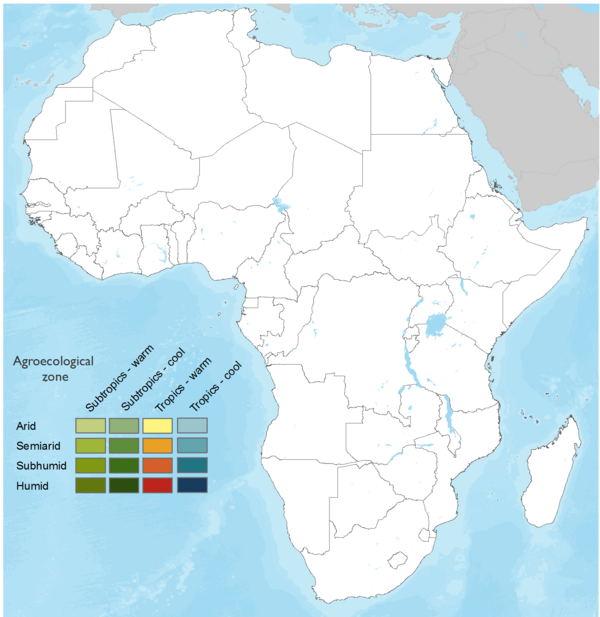
| AEZ | Subtropic - warm | Subtropic - cool | Tropic - warm | Tropic - cool |
|---|---|---|---|---|
| Arid | – | – | – | |
| Semiarid | – | – | – | |
| Subhumid | – | – | – | |
| Humid | – | – | – | – |
Source: HarvestChoice/IFPRI 2009
The United Nations Sustainable Development Goals that are applicable to this technology.

AWD reduces irrigation costs (fuel, labor, water fees), helping smallholder farmers lower production expenses and improve net income, especially in pump-irrigated systems.
AWD maintains or slightly improves rice yields while saving water. It enhances resilience to drought and supports stable food production, especially in water-stressed areas.
AWD reduces water use by 25–40%, conserving irrigation water and reducing pressure on shared or limited water resources. It also promotes more equitable water access within irrigation schemes.
AWD encourages efficient resource use—especially water and energy (fuel/electricity for pumps)—and supports sustainable rice intensification.
AWD significantly reduces methane emissions from flooded rice fields (up to 70%), making it a key practice in low-emission rice farming strategies and NDCs (Nationally Determined Contributions).
AWD relies on monitoring the water level below the soil surface using a simple tool called a Field Water Tube.
Here is a step-by-step guide on how to use the AWD technique clearly and in detail:
The field water tube is the key tool used to monitor the water level below the soil surface.
AWD cycles typically start about 15 days after sowing (DAS), or one to two weeks after transplanting, once the crop roots are established.
During the most sensitive stage of rice growth, continuous flooding must be temporarily maintained to protect the crop and secure the yield.
Last updated on 6 March 2026