Logo
TAAT e-catalog for Development partners
https://e-catalogs.taat-africa.org/org/technologies/short-term-fattening-and-supplemental-feeding
Request information View pitch brochure

Short-Term Fattening and Supplemental Feeding

Fast Feed, Fast Fatten, Fast Fortune: The Future of Livestock Farming!

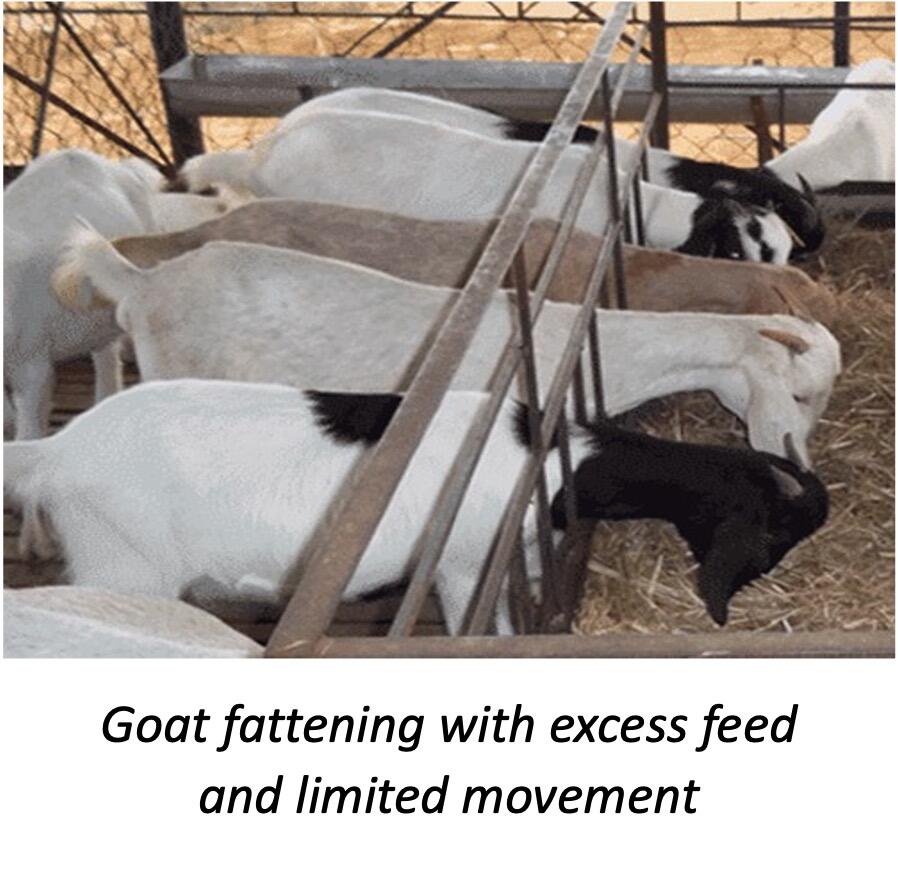
The technology is an intensive feeding method implemented within feedlots to efficiently bring animals to slaughter weight with optimal fat deposits. These facilities are strategically located near livestock markets and slaughterhouses, aiming for three rounds of fattening per year. The timing is often synchronized with festive seasons, capitalizing on peak demand and market prices. This approach not only ensures rapid and profitable turnover but also aligns with market dynamics, making goat and sheep fattening a lucrative and market-responsive agricultural practice.
2

This technology is TAAT1 validated.

7•7

Scaling readiness: idea maturity 7/9; level of use 7/9

Adults 18 and over: Positive high

The poor: Positive medium

Under 18: Positive low

Women: Positive medium

Climate adaptability: Highly adaptable

Farmer climate change readiness: Significant improvement

Biodiversity: No impact on biodiversity

Carbon footprint: Same amount of carbon released

Environmental health: Moderately improves environmental health

Soil quality: Does not affect soil health and fertility

Water use: Same amount of water used

Problem

  • Space Constraints: Livestock farming often requires extensive space, which may not be available for all farmers.
  • Risk Management: Livestock farming can be a risky venture, and farmers often seek methods that minimize these risks.
  • Time Constraints: Traditional livestock farming methods can take a long time to yield returns, which may not be suitable for farmers seeking quick results.
  • Acquisition of Suitable Animals: Finding and acquiring suitable young adult goats and sheep for fattening can be challenging.
  • Movement Restrictions: Implementing movement restrictions for intensive feeding in livestock can be difficult to manage.

Solution

  • Intensive Feedlot Farming: Utilizes less space by implementing intensive feeding methods within feedlots.
  • Rapid and Profitable Turnover: Minimizes risks by aiming for three rounds of fattening per year.
  • Quick Returns: Ensures returns within a short timeframe of three months.
  • Strategic Animal Selection: Recommends selecting animals of at least 20 kg in weight and avoiding older animals for fattening.
  • Effective Movement Restrictions: Provides solutions for implementing movement restrictions for intensive feeding.

Key points to design your program

Small Ruminant Fattening is a market-driven livestock production approach that uses short fattening cycles to increase the weight and market value of sheep and goats. By improving animal quality and market readiness within a short production period, the technology generates rapid income, strengthens livestock enterprise profitability, and supports rural livelihoods. It is well suited for livestock value chain development, rural livelihood improvement, youth employment, and income-generation programmes, contributing to SDGs 1 (No Poverty), 2 (Zero Hunger), 8 (Decent Work and Economic Growth), and 13 (Climate Action). The technology creates significant business opportunities for women and youth in livestock trading, feed supply, and small ruminant enterprises. To successfully integrate this technology, consider the following key actions :

  • Identify strategic production areas located near livestock markets and slaughter facilities to reduce transport costs and improve market access.
  • Establish partnerships with ILRI, national veterinary services, extension services, producer organizations, and private-sector actors to strengthen animal health, nutrition, and market development.
  • Invest in market-oriented infrastructure, including animal housing, feeding equipment, water supply systems, handling facilities, and other equipment required for efficient fattening operations.
  • Facilitate reliable feed supply networks by improving access to quality feed supplements, storage facilities, and local feed suppliers throughout the fattening cycle.
  • Strengthen technical and entrepreneurial capacity by training farmers, extension agents, and livestock entrepreneurs on animal selection, feeding regimes, animal health management, record keeping, and market-timed sales.
  • Promote the participation of women and youth through livestock fattening enterprises, feed supply businesses, livestock trading, and related value chain services.
  • Monitor programme performance through indicators such as weight gain, animal turnover rates, enterprise profitability, market performance, and the participation of women and youth.

70 USD

cost to finish a young animal in four months

IP

Open source / open access

Scaling Readiness describes how complete a technology\’s development is and its ability to be scaled. It produces a score that measures a technology\’s readiness along two axes: the level of maturity of the idea itself, and the level to which the technology has been used so far.

Each axis goes from 0 to 9 where 9 is the “ready-to-scale” status. For each technology profile in the e-catalogs we have documented the scaling readiness status from evidence given by the technology providers. The e-catalogs only showcase technologies for which the scaling readiness score is at least 8 for maturity of the idea and 7 for the level of use.

The graph below represents visually the scaling readiness status for this technology, you can see the label of each level by hovering your mouse cursor on the number.

Read more about scaling readiness ›

Scaling readiness score of this technology

Maturity of the idea 7 out of 9

Semi-controlled environment: prototype

Level of use 7 out of 9

Common use by projects NOT connected to technology provider

Maturity of the idea Level of use
9
8
7
6
5
4
3
2
1
1 2 3 4 5 6 7 8 9

Enabling Environments for Sustainable Regional Agriculture Extension (ENSURE)

  • Project funder: African Development Bank & East Africa Community

  • Planned Budget: USD 13.14 million

  • Location: East African Community (Burundi, DRC, Kenya, Rwanda, South Sudan, Tanzania, Uganda)

  • Planned duration: 2024–2027

  • Deployment means: On-farm demonstrations, training, digital tools (SMS, IVR, video, radio, pictorial guides), bundled inputs + advisory services, Training of Trainers (ToT)

  • Project main implementer: East African Community (EAC)

  • Project Description: Strengthen agricultural extension systems using digital tools, private-sector approaches, regional coordination, and multi-commodity focus (maize, cassava, rice, drought-resilient crops).

  • Objective: Promote regional extension, enhance advisory services, scale climate-smart technologies, build sustainable private sector–led extension systems, strengthen policy and regulatory frameworks.

  • Expected outcome: Increased adoption of improved technologies, improved farmer productivity and profitability, enhanced access to quality inputs and pest management solutions, strengthened resilience to climate and pest risks, regional market integration, job creation for youth and agripreneurs.

  • Figures of adoption: Target 3 million farmers reached over 4 years, digital extension pilots in 7 EAC states, training of extension agents, lead farmers, cooperatives, and youth agripreneurs, rollout of Pest Information Management Systems (PIMS).

  • Profiles of adopters: Smallholder farmers, women, youth agripreneurs, cooperatives and producer organizations, public and private extension agents, National Plant Protection Officers (NPPOs).

  • Lessons learnt: System-level approaches needed beyond technology delivery, digital tools most effective with in-person facilitation, supportive policy/regulatory environment critical, regional harmonization boosts scalability and cross-border diffusion of technologies. 

Countries with a green colour
Tested & adopted
Countries with a bright green colour
Adopted
Countries with a yellow colour
Tested
Countries with a blue colour
Testing ongoing
Egypt Equatorial Guinea Ethiopia Algeria Angola Benin Botswana Burundi Burkina Faso Democratic Republic of the Congo Djibouti Côte d’Ivoire Eritrea Gabon Gambia Ghana Guinea Guinea-Bissau Cameroon Kenya Libya Liberia Madagascar Mali Malawi Morocco Mauritania Mozambique Namibia Niger Nigeria Republic of the Congo Rwanda Zambia Senegal Sierra Leone Zimbabwe Somalia South Sudan Sudan South Africa Eswatini Tanzania Togo Tunisia Chad Uganda Western Sahara Central African Republic Lesotho
Countries where the technology is being tested or has been tested and adopted
Country Testing ongoing Tested Adopted
Burkina Faso No ongoing testing Tested Adopted
Cameroon No ongoing testing Tested Adopted
Ethiopia No ongoing testing Tested Adopted
Kenya No ongoing testing Tested Adopted
Niger No ongoing testing Tested Adopted
Nigeria No ongoing testing Tested Adopted
Somalia No ongoing testing Tested Adopted
South Sudan No ongoing testing Tested Adopted
Tanzania No ongoing testing Tested Adopted
Uganda No ongoing testing Tested Adopted

This technology can be used in the colored agro-ecological zones. Any zones shown in white are not suitable for this technology.
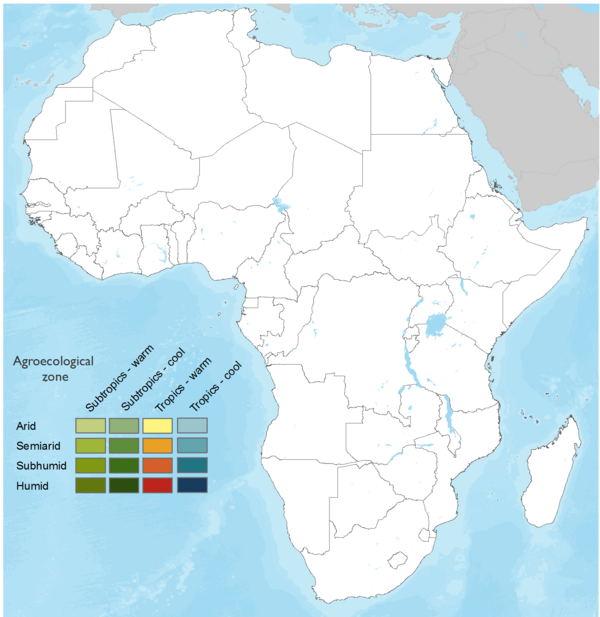

Agro-ecological zones where this technology can be used
AEZ Subtropic - warm Subtropic - cool Tropic - warm Tropic - cool
Arid
Semiarid
Subhumid
Humid

Source: HarvestChoice/IFPRI 2009

The United Nations Sustainable Development Goals that are applicable to this technology.
Sustainable Development Goal 2: zero hunger
Goal 2: zero hunger
Sustainable Development Goal 8: decent work and economic growth
Goal 8: decent work and economic growth

  1. Critical Initial Selection: The technology begins with a crucial step of selecting healthy animals without physical defects, emphasizing those with large skeletal frames for greater potential gain.
  2. Castration Influence: For males, castration is highlighted as a practice that influences both fattening and the tastiness of meat.
  3. Breed Consideration: Certain breeds are identified as having better potential for growth and quicker adjustment to fattening regimes.
  4. Age and Weight Criteria: Animals beyond four years old are deemed unsuitable for fattening, and a minimum weight requirement of at least 20 kg is recommended.
  5. Dietary Composition: The first two weeks involve including grass and hay in the diet, with a gradual reduction over time.
  6. Sorting and Group Rearing: Where possible, sorting animals based on weight and gender is suggested, and raising them in groups for efficiency.
  7. Identification and Culling: Animals not adjusting to intensive feeding should be identified and culled promptly from the fattening stock.
  8. Feed Access Requirement: Each animal should have 15 to 20 linear centimeters of feed access.
  9. Shelter Maintenance: Shelters should be cleaned regularly to minimize the threats of pests and diseases.
  10. Animal Management Practices: All animals should be ear-tagged for identification, undergo deworming, and be weighed weekly for monitoring and management purposes.

Last updated on 3 July 2026