
TAAT e-catalog
for
government
https://e-catalogs.taat-africa.org/gov/technologies/tubewell-shallow-groundwater-tubewell
Easy Water Access for Every Smallholder
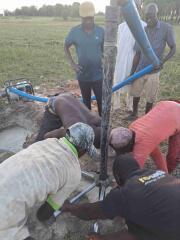
The Shallow Groundwater Tubewell is a simple technology for accessing groundwater based on drilling a narrow, shallow well (to a depth less than 20 m), mainly in floodplains with sedimentary formation. A PVC pipe (50 or 63 mm) is installed in the aquifer, and water is pumped using a small 5 to 8 hp pump, which can be powered by gasoline or solar energy. Drilling is carried out using a hand auger or jetting, two inexpensive methods suitable for alluvial, sandy, clay or loamy formation. With a flow rate of 0.5 to 5 m³/hour, this technology provides a reliable water supply for irrigating small farms while limiting costs and technical complexity associated with pumping water from long distances.
This technology is pre-validated.
Adults 18 and over: Positive high
Applicable to adult farmers
The poor: Positive high
It is affordable and within the reach of poor resource farmers
Under 18: Positive medium
The technology, where there is shallow groundwater aquifer, especially in lowland sedimentary formations, could be used by anyone, young women, and adult farmers. It is gender friendly and affordable.
Women: Positive high
Easy to use for women in agriculture for vegetable production
Climate adaptability: Highly adaptable
The technology uses groundwater where the annual recharge of the aquifer is high and sustainable.
Farmer climate change readiness: Moderate improvement
This technology enables access to a more stable water resource as part of adaptation strategy to climatic variations, supporting farmers to better manage periods of drought and water uncertainty, with other good agricultural practices needed in crop production.
Biodiversity: Positive impact on biodiversity
This technology promotes sustainable use of groundwater aquifer for irrigation with less disruption to soils and ecosystems, supports the preservation of natural habitats, and encourages local biological diversity.
Carbon footprint: A bit less carbon released
Using low-energy pumps that can run on solar power, it generates significantly less CO2 emissions than conventional motorized systems that run on fossil fuels.
Environmental health: Greatly improves environmental health
This approach reduces fuel-related pollution, limits deforestation for energy resources, and protects groundwater by ensuring controlled and sustainable extraction.
Soil quality: Improves soil health and fertility
By preventing excessive leaching and allowing for adequate water supply, it helps maintain good soil structure and nutrient richness in agricultural soils.
Water use: Same amount of water used
The technology allows farmers to meet the crop water requirement in the dry season and to mitigate dry spells.
Tubewell technology offers a simple and economical method for accessing shallow groundwater (< 20 m) in floodplains, enabling reliable irrigation that is suitable for smallholder farmers. It contributes to the goals of agricultural resilience, sustainable water management, and food security in rural areas.
By following these recommendations, tubewells enable farmers to access groundwater sustainably, improve productivity, and strengthen agricultural resilience while supporting sustainable water resource management.
Every USD invested returns USD 1.87 net income.
Open source / open access
Scaling Readiness describes how complete a technology's development is and its ability to be scaled. It produces a score that measures a technology's readiness along two axes: the level of maturity of the idea itself, and the level to which the technology has been used so far.
Each axis goes from 0 to 9 where 9 is the “ready-to-scale” status. For each technology profile in the e-catalogs we have documented the scaling readiness status from evidence given by the technology providers. The e-catalogs only showcase technologies for which the scaling readiness score is at least 8 for maturity of the idea and 7 for the level of use.
The graph below represents visually the scaling readiness status for this technology, you can see the label of each level by hovering your mouse cursor on the number.
Read more about scaling readiness ›
Uncontrolled environment: validated
Common use by intended users, in the real world
| Maturity of the idea | Level of use | |||||||||
| 9 | ||||||||||
| 8 | ||||||||||
| 7 | ||||||||||
| 6 | ||||||||||
| 5 | ||||||||||
| 4 | ||||||||||
| 3 | ||||||||||
| 2 | ||||||||||
| 1 | ||||||||||
| 1 | 2 | 3 | 4 | 5 | 6 | 7 | 8 | 9 | ||
| Project | Countries | Beneficiaries | Budget (USD) & duration | Key figures |
|---|---|---|---|---|
|
Agro-Industrial Zones Promotion of Sustainable Agricultural Value Chains in Special Agro-Industrial Processing Zones Program |
|
|
285.38 million African Development Bank (AfDB) 2024–2029 |
|
|
EFPP(AEFPF) Emergency Food Production Project (AEFPF) |
|
|
25.5 million African Development Bank (AfDB) 2022–2026 |
|
|
SSEFPP-1 SSEFPP-1 Emergency Food Production Plan |
|
|
8.1 million African Development Bank (AfDB) 2022–2023 |
|
Figures in italic are from project plans and may change during implementation.
|
Cost of the investment Sum of all fixed and operational expenses. |
USD 900 per hectare |
|---|---|
|
Gross revenue Sum of all income before subtracting costs. |
USD 2,587 per hectare |
|
Net income Gross revenue minus total cost. |
USD 1,687 per hectare |
|
Return on investment Percentage of income earned for each dollar invested, calculated as: (income ÷ cost of investment) × 100 |
187 % per hectare |
| Country | Testing ongoing | Tested | Adopted |
|---|---|---|---|
| Benin | –No ongoing testing | –Not tested | Adopted |
| Burkina Faso | –No ongoing testing | Tested | –Not adopted |
| Ghana | –No ongoing testing | –Not tested | Adopted |
| Mali | –No ongoing testing | Tested | –Not adopted |
| Nigeria | –No ongoing testing | –Not tested | Adopted |
| Togo | –No ongoing testing | –Not tested | Adopted |
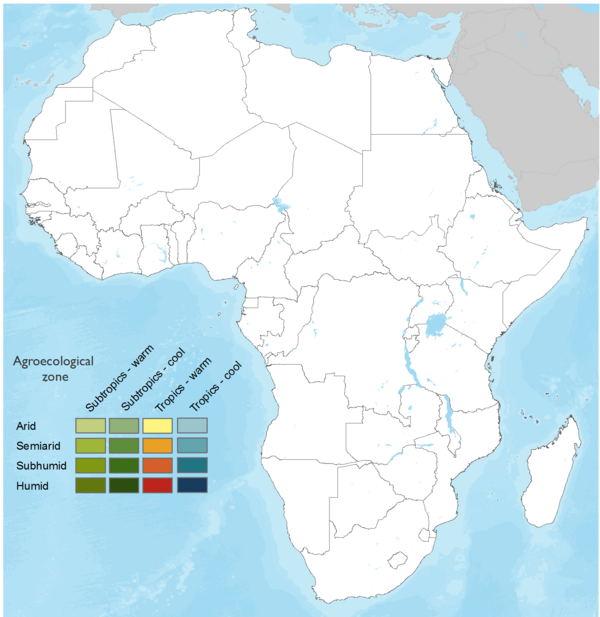
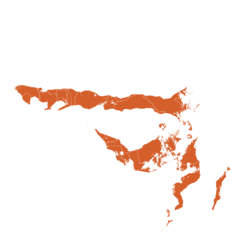
This technology can be used in the colored agro-ecological zones. Any zones shown in white are not suitable for this technology.

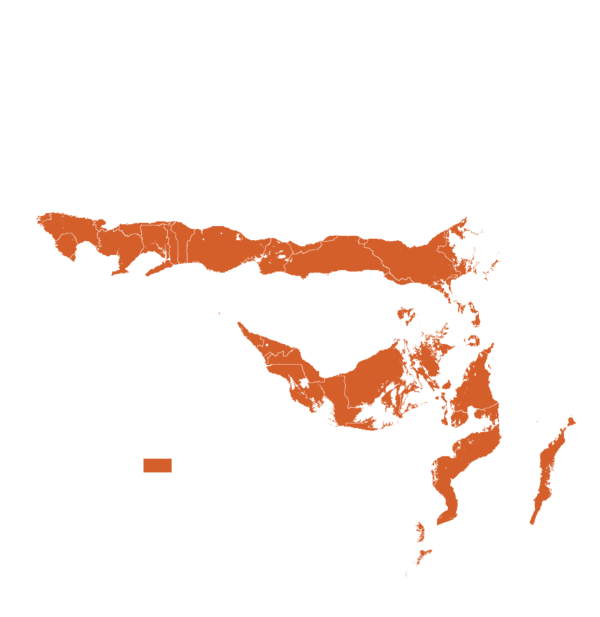
| AEZ | Subtropic - warm | Subtropic - cool | Tropic - warm | Tropic - cool |
|---|---|---|---|---|
| Arid | – | – | – | – |
| Semiarid | – | – | – | |
| Subhumid | – | – | – | |
| Humid | – | – | – | – |
Source: HarvestChoice/IFPRI 2009
The United Nations Sustainable Development Goals that are applicable to this technology.
Supports all-year crop production with direct impact of household food production
1. Assess the site
Check that the groundwater is shallow (< 20 m) and that the geological formation is suitable, preferably sedimentary soils such as alluvium, sand, clay, or silt.
2. Choose the drilling method
Opt for manual auger or jetting depending on the type of soil and the depth of the aquifer. These methods are simple, economical, and suitable for smallholders.
3. Prepare the equipment
Gather the necessary equipment: PVC pipes for the well, pipes and hoses for the pump, a 5–8 hp pump, and drilling accessories (rods, bits, or jetting swivels).
4. Drill the well
Dig the well until you reach water using the chosen method. Jetting uses water circulation to remove debris, while manual augering requires turning steel rods.
5. Install the casing
Lower the slotted PVC pipes into the borehole, add a bed of gravel to filter sediment, then backfill to stabilize the well.
6. Connect the pump and test
Attach the pump to the tubewell and test the flow rate by pumping into a container for a set period of time to verify that the water is flowing properly.
7. Use and maintain
Before each use, check the pump's fuel and oil. Avoid air bubbles during pumping and keep the well protected by closing it after use to prevent contamination.
Last updated on Sep 10, 2026
This technology can be used in the colored agro-ecological zones.



Tubewell: Shallow Groundwater Tubewell
https://e-catalogs.taat-africa.org/gov/technologies/tubewell-shallow-groundwater-tubewell
Last updated on 10 September 2026, printed on Oct 23, 2026
Enquiries e-catalogs@taat.africa