
TAAT e-catalog
for
government
https://e-catalogs.taat-africa.org/gov/technologies/livestock-feed-pelleting-small-scale-feed-production-using-local-agricultural-by-products
Farm-to-Feed Innovation: Turning local by-products into affordable, high-quality livestock feed
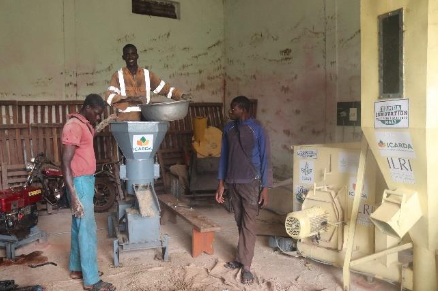
Small-scale Feed Production Using Local Agricultural By-products is an integrated feed production technology combining locally available agricultural and agro-industrial resources, balanced feed formulations, capacity building, and appropriately selected processing equipment. Feed ingredients are selected based on local availability and livestock nutritional requirements, then ground, mixed, and, where appropriate, pelletized using equipment configurations suited to local production capacity, infrastructure, and energy availability. The technology enables decentralized feed production through configurations ranging from basic grinding and mixing units to complete grinder-mixer-pelletizer lines. This flexibility allows feed production systems to be built around locally available resources and operating conditions rather than requiring a standardized processing line.
This technology is pre-validated.
| Target Groups | Positive Impacts |
|---|---|
| Young women smallholder livestock producers in remote areas |
|
| Women in resource-poor farmer organizations and cooperatives |
|
| Young members of resource-poor farmer organizations and cooperatives |
|
| Remote smallholder livestock producers |
|
Climate adaptability: Highly adaptable
Can be adapted to different agroecological contexts by using locally available agricultural and agro-industrial by-products for livestock feed production.
Farmer climate change readiness: Moderate improvement
Helps farmers maintain livestock productivity during feed shortages by converting locally available agricultural by-products into livestock feed.
Biodiversity: Positive impact on biodiversity
Helps reduce pressure on natural grazing lands by providing an alternative livestock feed from locally available by-products.
Carbon footprint: A bit less carbon released
Promotes locally produced livestock feed from agricultural by-products, reducing reliance on imported feed and associated transport emissions.
Environmental health: Moderately improves environmental health
Promotes the productive use of agricultural and agro-industrial by-products through a circular resource-use approach.
Water use: Same amount of water used
The feed processing steps do not significantly change water use compared with existing livestock feed production practices.
Small-scale Feed Production Using Local Agricultural By-products provides an adaptable solution to strengthen domestic livestock feed production, reduce dependence on imported feed concentrates, and improve feed availability during seasonal and climate-induced shortages. By valorizing locally available agricultural and agro-industrial by-products, the technology supports feed security, climate-resilient livestock production, local enterprise development, and more sustainable use of grazing resources. To successfully integrate this technology:
Every USD invested returns USD 0.09 net income.
Open source / open access
Scaling Readiness describes how complete a technology's development is and its ability to be scaled. It produces a score that measures a technology's readiness along two axes: the level of maturity of the idea itself, and the level to which the technology has been used so far.
Each axis goes from 0 to 9 where 9 is the “ready-to-scale” status. For each technology profile in the e-catalogs we have documented the scaling readiness status from evidence given by the technology providers. The e-catalogs only showcase technologies for which the scaling readiness score is at least 8 for maturity of the idea and 7 for the level of use.
The graph below represents visually the scaling readiness status for this technology, you can see the label of each level by hovering your mouse cursor on the number.
Read more about scaling readiness ›
Uncontrolled environment: validated
Used by some intended users, in the real world
| Maturity of the idea | Level of use | |||||||||
| 9 | ||||||||||
| 8 | ||||||||||
| 7 | ||||||||||
| 6 | ||||||||||
| 5 | ||||||||||
| 4 | ||||||||||
| 3 | ||||||||||
| 2 | ||||||||||
| 1 | ||||||||||
| 1 | 2 | 3 | 4 | 5 | 6 | 7 | 8 | 9 | ||
-
| Target Groups | Positive Impacts |
|---|---|
| Young women smallholder livestock producers in remote areas |
|
| Women in resource-poor farmer organizations and cooperatives |
|
| Young members of resource-poor farmer organizations and cooperatives |
|
| Remote smallholder livestock producers |
|
| Target Groups | Potential Unintended Impacts | Mitigation Measures |
|---|---|---|
| Young women smallholder livestock producers in remote areas |
|
|
| Women in resource-poor farmer organizations and cooperatives |
|
|
| Young members of resource-poor farmer organizations and cooperatives |
|
|
| Remote smallholder livestock producers |
|
|
| Target Groups | Primary Adoption Barriers | Actionable Mitigation Measures |
|---|---|---|
| Young women smallholder livestock producers in remote areas |
|
|
| Women in resource-poor farmer organizations and cooperatives |
|
|
| Young members of resource-poor farmer organizations and cooperatives |
|
|
| Remote smallholder livestock producers |
|
|
|
Cost of the investment Sum of all fixed and operational expenses. |
USD 44,250 Per ton of feed produced |
|---|---|
|
Gross revenue Sum of all income before subtracting costs. |
USD 48,438 Per ton of feed produced |
|
Net income Gross revenue minus total cost. |
USD 4,188 Per ton of feed produced |
|
Return on investment Percentage of income earned for each dollar invested, calculated as: (income ÷ cost of investment) × 100 |
9 % year |
| Country | Testing ongoing | Tested | Adopted |
|---|---|---|---|
| Ethiopia | –No ongoing testing | Tested | Adopted |
| Mali | –No ongoing testing | Tested | Adopted |
| Tunisia | –No ongoing testing | Tested | Adopted |
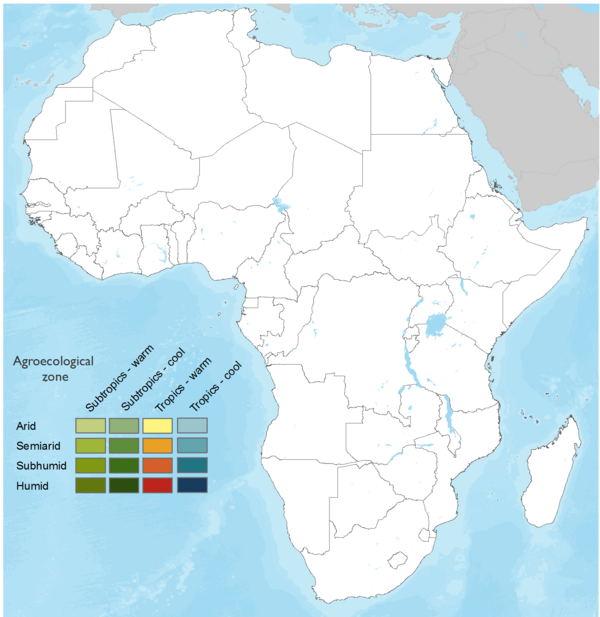
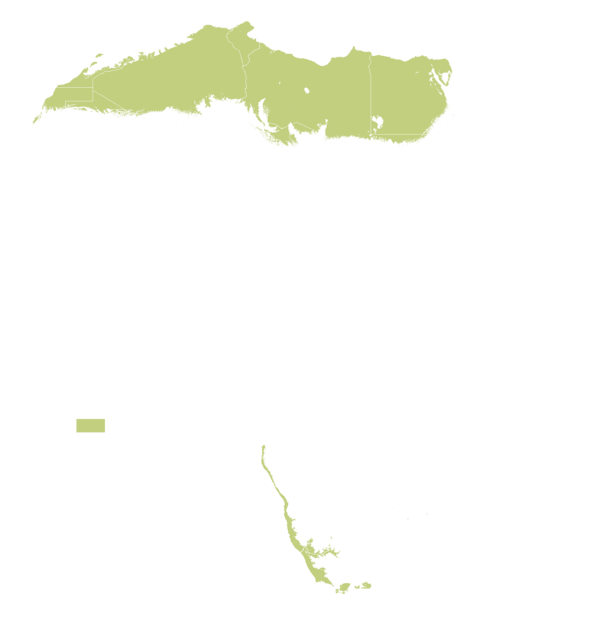
This technology can be used in the colored agro-ecological zones. Any zones shown in white are not suitable for this technology.



| AEZ | Subtropic - warm | Subtropic - cool | Tropic - warm | Tropic - cool |
|---|---|---|---|---|
| Arid | – | – | – | |
| Semiarid | – | |||
| Subhumid | – | – | – | – |
| Humid | – | – | – | – |
Source: HarvestChoice/IFPRI 2009
The United Nations Sustainable Development Goals that are applicable to this technology.
Reduces livestock feeding costs, improves livestock productivity, and increases farmers' income through locally produced feed.
Strengthens year-round livestock feed availability, improving livestock productivity and contributing to food security.
Reduces the time and physical labour traditionally associated with animal feeding, creating opportunities for women to engage in other productive activities.
Creates business and employment opportunities through feed processing, equipment manufacturing, and feed pelleting services.
Promotes the productive use of agricultural and agro-industrial by-products through circular resource use and local feed production.
Strengthens livestock resilience to drought by providing locally produced feed from agricultural and agro-industrial by-products.
The technology is implemented by first identifying suitable local by-products and developing balanced feed formulations, then designing a small-scale processing unit adapted to local production needs, infrastructure, energy availability, and business conditions.
Step 1 – Identify locally available by-products: Identify suitable agricultural and agro-industrial by-products and assess their availability, seasonality, nutritional value, and cost.
Step 2 – Develop balanced feed formulations: Combine selected by-products with other necessary feed ingredients according to livestock nutritional requirements and locally available resources.
Step 3 – Design the appropriate processing unit: Select the type, capacity, and combination of equipment according to local conditions. Depending on production needs, infrastructure, energy availability, and investment capacity, the unit may include a grinder, mixer, pelletizer, or a simpler equipment configuration.
Step 4 – Build technical and business capacity: Train operators and farmer organizations in feed formulation, equipment operation and maintenance, feed quality management, and business management.
Step 5 – Produce and store the feed: Grind and mix the formulated ingredients and, where appropriate, pelletize the feed. Store the processed feed under suitable conditions to maintain its quality and availability.
Step 6 – Establish the production or service model: Use the unit for feed production and sale or provide feed-processing services to farmers and cooperative members.
Step 7 – Monitor and adapt operations: Monitor feed quality, production costs, equipment performance, ingredient availability, energy supply, and market demand, and adjust the formulation or processing system as needed.
Last updated on Sep 16, 2026
This technology can be used in the colored agro-ecological zones.






Livestock Feed Pelleting: Small-scale feed production using local agricultural by-products
https://e-catalogs.taat-africa.org/gov/technologies/livestock-feed-pelleting-small-scale-feed-production-using-local-agricultural-by-products
Last updated on 16 September 2026, printed on Oct 22, 2026
Enquiries e-catalogs@taat.africa