TAAT e-catalog
for
government
https://e-catalogs.taat-africa.org/gov/technologies/integrated-orobanche-management-on-faba-bean-resistant-faba-bean-and-low-dose-herbicide-package
Restoring faba bean productivity by defeating Orobanche.
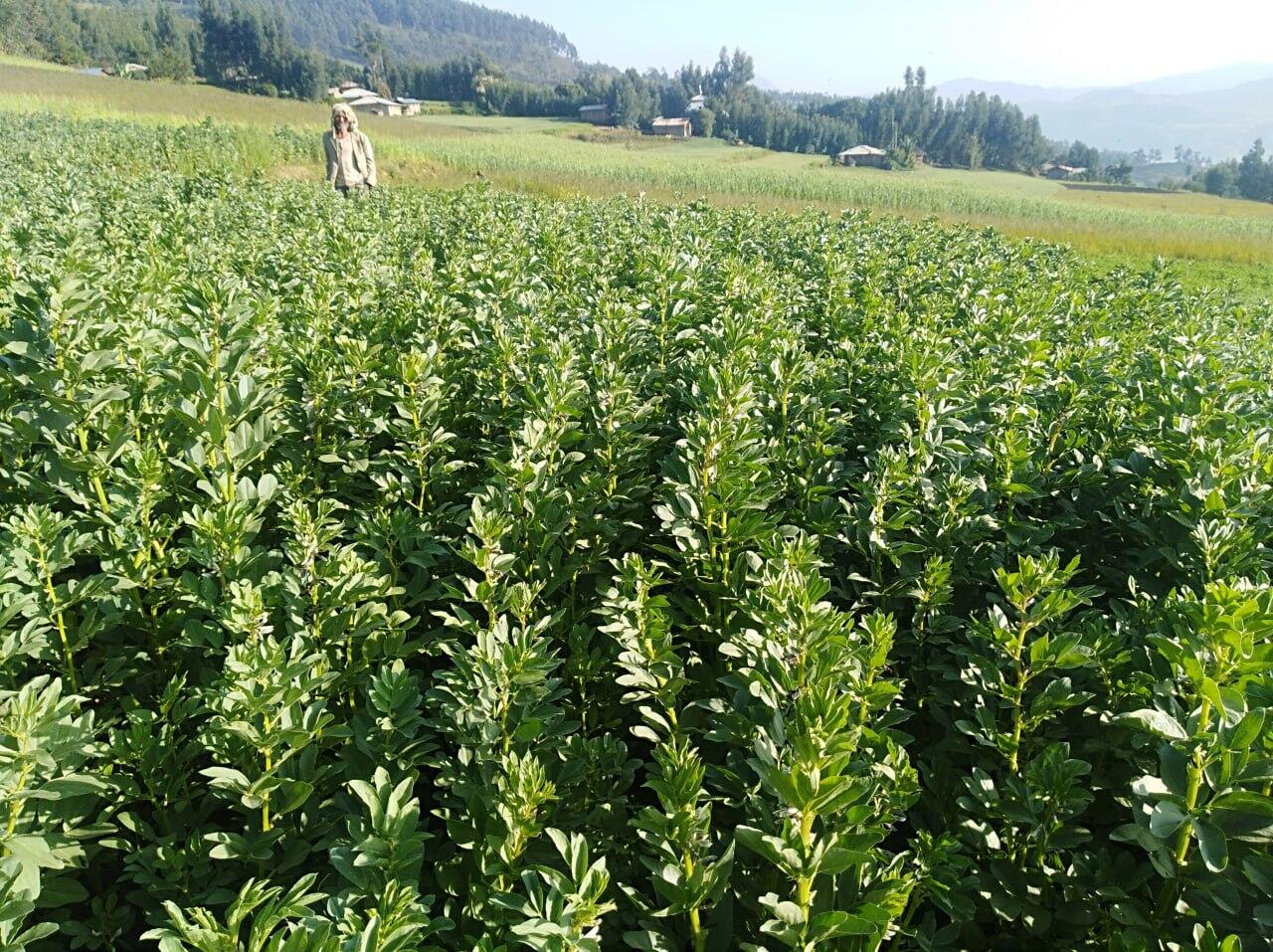
Integrated Orobanche Management (IOM) is a proven integrated weed management package that combines a partially resistant faba bean variety with low-dose Glyphosate application to effectively control Orobanche crenata, a major constraint to faba bean production. By restoring productivity in infested fields, the technology contributes to national food security, improves household nutrition through increased pulse production, and enhances soil fertility by promoting faba bean cultivation within crop rotations. Successfully validated through participatory Farmer Research Extension Groups (FREGs), the technology has demonstrated high farmer acceptance and is ready for large-scale dissemination across Orobanche-affected regions.
This technology is pre-validated.
|
Social Group |
Positive Impacts |
|
Women smallholder faba bean farmers |
• Improved access to resistant faba bean varieties and integrated crop management practices. |
|
Resource-poor smallholder farmers in Orobanche-affected areas |
• Recovery of previously low-performing or abandoned faba bean fields affected by Orobanche infestation. |
|
Youth engaged in agricultural value chains |
• Creation of business opportunities in seed multiplication, agro-input supply, and agricultural services. |
|
Farmers’ organizations and cooperatives in pulse-producing communities |
• Increased collective production capacity and marketable surplus of faba bean. |
Climate adaptability: Highly adaptable
Helps farmers maintain faba bean production under increasing climate stress, as drought conditions can increase Orobanche pressure and threaten crop productivity.
Farmer climate change readiness: Moderate improvement
Strengthens resilience by providing farmers with an integrated management package, but adoption requires access to improved seed, inputs, and technical support.
Biodiversity: Positive impact on biodiversity
Supports crop diversity by maintaining faba bean cultivation and promoting crop rotations, but responsible herbicide use is needed to minimize impacts on non-target organisms.
Carbon footprint: A bit less carbon released
Improves soil nitrogen availability through legume-based rotations, reducing the need for synthetic nitrogen fertilizers; however, herbicide production and application contribute some emissions.
Environmental health: Moderately improves environmental health
Promotes sustainable Orobanche management through integrated practices and reduced chemical doses but requires proper Glyphosate handling to avoid environmental contamination.
Soil quality: Improves soil health and fertility
Maintains faba bean in crop rotations, improving soil fertility through nitrogen fixation and reducing soil degradation in affected areas.
Water use: A bit less water used
Does not directly reduce water requirements, but improved crop productivity and resilience help farmers obtain better returns from available water resources, especially under drought conditions.
The Integrated Orobanche Management technology should be implemented as an integrated faba bean production and Orobanche management intervention, combining the use of the Hashenge partially resistant faba bean variety, targeted Glyphosate application, and complementary cultural practices. The technology should be embedded within existing government agricultural development programs, pulse sector initiatives, extension systems, and seed delivery mechanisms to ensure efficient coordination, sustainability, and large-scale impact.
Project design should begin with the identification of priority intervention areas based on Orobanche prevalence, faba bean production importance, and existing institutional capacity. Government agencies, research institutions, and development partners should work together to define target regions, implementation modalities, and monitoring frameworks.
Successful deployment requires coordinated access to the main components of the technology package, including the partially resistant Hashenge faba bean variety, appropriate crop protection inputs, and complementary agronomic support. Implementation plans should ensure the availability of these resources through strengthened seed systems, input supply networks, and institutional partnerships.
The technology should be promoted as an integrated management package combining resistant varieties, targeted herbicide use, and complementary practices that contribute to long-term reduction of Orobanche pressure. Project activities should include awareness creation, technical capacity building, demonstration activities, and continuous support through extension and research networks.
Capacity building should involve agricultural extension services, research organizations, and relevant stakeholders to strengthen technical knowledge on integrated Orobanche management. Training programs should focus on technology dissemination, quality assurance, safe input management, monitoring of adoption, and effective scaling approaches.
Implementation should be supported through strong collaboration among key institutions, including the Amhara Agricultural Research Institute (ARARI), the Ethiopian Institute of Agricultural Research (EIAR), ICARDA, government extension services, farmer organizations, and private-sector input providers. These partnerships are essential for ensuring access to research expertise, strengthening delivery systems, and facilitating sustainable adoption.
Government programs should establish monitoring mechanisms to assess technology uptake, productivity improvements, reduction of Orobanche pressure, livelihood impacts, and contributions to food security and sustainable agricultural development.
By integrating IOM into broader agricultural transformation strategies, decision-makers can restore productivity in Orobanche-affected areas, strengthen the pulse sector, improve food and nutrition security, enhance farmer resilience, and support more sustainable crop production systems. The technology provides a scalable solution to address a major biological constraint affecting faba bean production.
Open source / open access
Scaling Readiness describes how complete a technology's development is and its ability to be scaled. It produces a score that measures a technology's readiness along two axes: the level of maturity of the idea itself, and the level to which the technology has been used so far.
Each axis goes from 0 to 9 where 9 is the “ready-to-scale” status. For each technology profile in the e-catalogs we have documented the scaling readiness status from evidence given by the technology providers. The e-catalogs only showcase technologies for which the scaling readiness score is at least 8 for maturity of the idea and 7 for the level of use.
The graph below represents visually the scaling readiness status for this technology, you can see the label of each level by hovering your mouse cursor on the number.
Read more about scaling readiness ›
Uncontrolled environment: validated
Common use by intended users, in the real world
| Maturity of the idea | Level of use | |||||||||
| 9 | ||||||||||
| 8 | ||||||||||
| 7 | ||||||||||
| 6 | ||||||||||
| 5 | ||||||||||
| 4 | ||||||||||
| 3 | ||||||||||
| 2 | ||||||||||
| 1 | ||||||||||
| 1 | 2 | 3 | 4 | 5 | 6 | 7 | 8 | 9 | ||
|
Social Group |
Positive Impacts |
|
Women smallholder faba bean farmers |
• Improved access to resistant faba bean varieties and integrated crop management practices. |
|
Resource-poor smallholder farmers in Orobanche-affected areas |
• Recovery of previously low-performing or abandoned faba bean fields affected by Orobanche infestation. |
|
Youth engaged in agricultural value chains |
• Creation of business opportunities in seed multiplication, agro-input supply, and agricultural services. |
|
Farmers’ organizations and cooperatives in pulse-producing communities |
• Increased collective production capacity and marketable surplus of faba bean. |
|
Social Group |
Potential Unintended Impacts |
Mitigation Measures |
|
Women smallholder faba bean farmers |
Increased labour burden due to additional management practices |
• Promote labour-sharing mechanisms through farmer groups. |
|
Resource-poor smallholder farmers in Orobanche-affected areas |
Dependence on external inputs and services |
• Strengthen local seed multiplication and input supply systems. |
|
Youth engaged in agricultural value chains |
Unequal access to emerging business opportunities |
• Provide entrepreneurship training and technical capacity building. |
|
Farmers’ organizations and cooperatives |
Potential exclusion of smaller or less-connected farmers |
• Establish inclusive membership and participation mechanisms. |
|
Social Group |
Adoption Barriers |
Mitigation Measures |
|
Women smallholder faba bean farmers |
Limited access to resources and information |
• Organize women-focused training and demonstration activities. |
|
Resource-poor smallholder farmers in Orobanche-affected areas |
High initial adoption constraints |
• Provide demonstration plots showing economic benefits. |
|
Youth engaged in agricultural value chains |
Limited investment capacity and technical experience |
• Link youth with agribusiness development programs. |
|
Farmers’ organizations and cooperatives |
Weak organizational capacity and market linkages |
• Strengthen cooperative management and business skills. |
| Country | Testing ongoing | Tested | Adopted |
|---|---|---|---|
| Ethiopia | –No ongoing testing | Tested | Adopted |
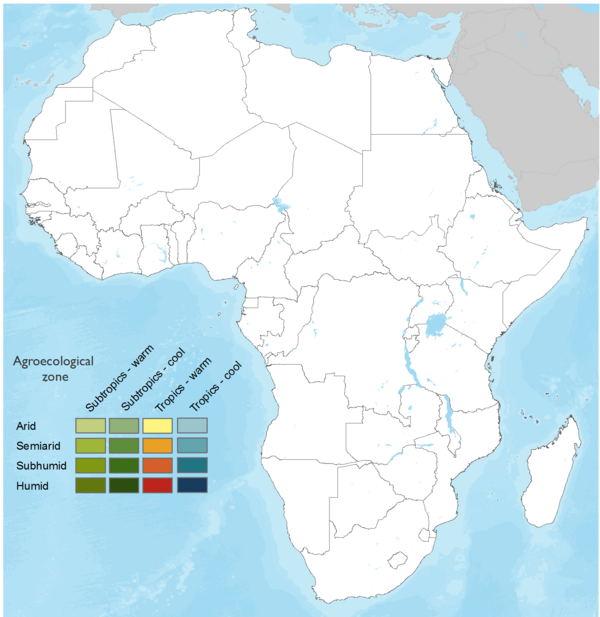
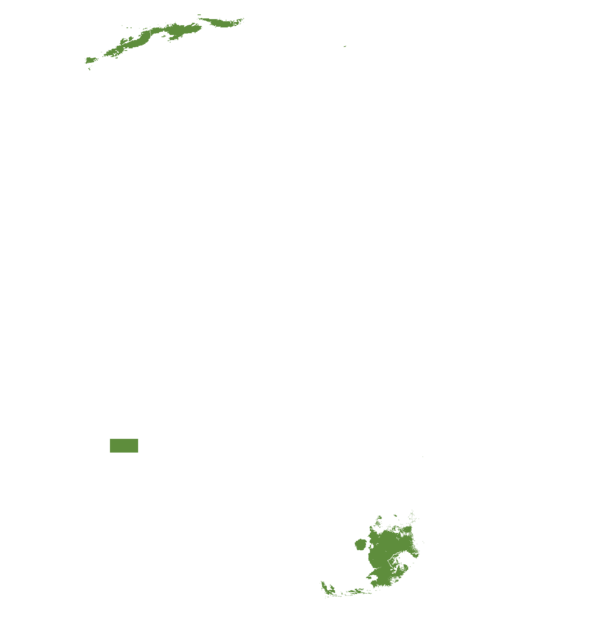
This technology can be used in the colored agro-ecological zones. Any zones shown in white are not suitable for this technology.
| AEZ | Subtropic - warm | Subtropic - cool | Tropic - warm | Tropic - cool |
|---|---|---|---|---|
| Arid | – | – | – | – |
| Semiarid | – | – | – | |
| Subhumid | – | – | – | – |
| Humid | – | – | – | – |
Source: HarvestChoice/IFPRI 2009
The United Nations Sustainable Development Goals that are applicable to this technology.
Increases faba bean productivity and profitability, helping smallholder farmers recover income from Orobanche-affected fields and improve livelihood resilience.
Promotes efficient production through integrated pest management, combining resistant varieties, targeted herbicide use, and cultural practices.
Demonstrates successful collaboration among ICARDA, EIAR, ARARI, extension services, and farmers for technology development and scaling.
Restores production of faba bean, an important source of affordable protein, improving household food security and dietary quality.
Last updated on Sep 14, 2026
This technology can be used in the colored agro-ecological zones.



Integrated Orobanche Management on Faba bean: Resistant Faba Bean and Low-Dose Herbicide Package
https://e-catalogs.taat-africa.org/gov/technologies/integrated-orobanche-management-on-faba-bean-resistant-faba-bean-and-low-dose-herbicide-package
Last updated on 14 September 2026, printed on Oct 23, 2026
Enquiries e-catalogs@taat.africa