Logo
TAAT e-catalog for government
https://e-catalogs.taat-africa.org/gov/technologies/gender-transformative-dialogues-for-womens-decision-making-on-productive-assets
Request information View pitch brochure

Gender-Transformative Dialogues for Women’s Decision-Making on Productive Assets

Women Decide. Women Choose. Women Control Productive Assets!

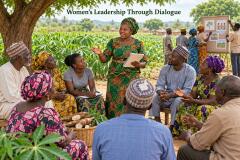
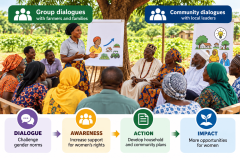
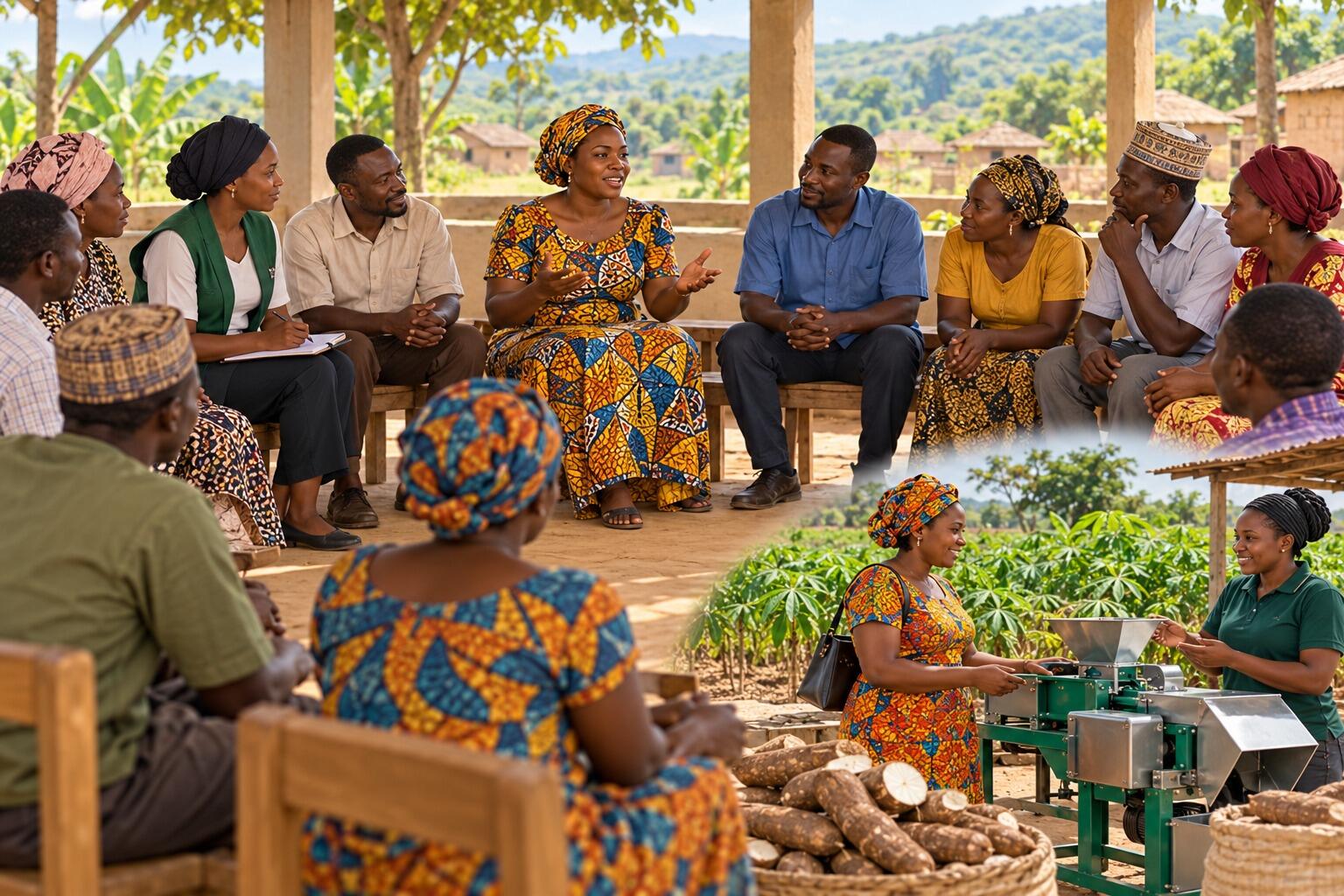
The Gender-Transformative Dialogue Sessions are group sessions designed to strengthen women’s ability to buy and sell productive assets without seeking permission from their husbands. The approach provides a structured way to address gender norms, unequal household responsibilities, decision-making, and restrictions on women’s control over productive assets. It follows a participatory process in which participants first examine gender roles and household practices, then analyse how these practices affect women’s access to and control over productive assets. Discussions, brainstorming, critical reflection, practical exercises, case studies, and real-life experiences are used to encourage participants to question restrictive attitudes and identify possible changes. The approach also includes positive masculinity, engagement of men as allies, identification of role models, and sharing of success stories to encourage positive changes in attitudes and relationships. Participants are supported to develop practical action plans and commitments that promote more equal decision-making and shared responsibilities within households.
This technology is not yet validated.

6•4

Scaling readiness: idea maturity 6/9; level of use 4/9

Positive impacts: 9

Target Groups Positive Impacts
Young women smallholder farmers with disabilities
  • Increased confidence to express their views on household roles and responsibilities.
  • Better participation in group discussions and activities.
  • Stronger involvement in household discussions about productive assets.
Women smallholder farmers from socially marginalized and disadvantaged communities
  • Improved ability to question restrictive social norms affecting women’s economic roles.
  • Better inclusion in group activities related to household and economic decision-making.
  • Stronger support for more equitable relationships within households and communities.
Women smallholder farmers with limited resources
  • Improved ability to make decisions about buying and selling productive assets without seeking permission from their husbands.
  • Better understanding of how productive-asset decisions support participation in the cassava agrifood system.
  • Practical household action plans that reflect available resources and responsibilities.
More...

Climate adaptability: Highly adaptable

The technology can be adapted to different climatic conditions and integrated into existing cassava initiatives through local partners and organized groups of women and men.

Farmer climate change readiness: Significant improvement

The technology supports women’s economic resilience across the cassava value chain, strengthening their capacity to anticipate, cope with, adapt to, and recover from climate-related shocks and stresses.

Problem

  • Gender inequality in resource control: Gender norms give men greater control over productive resources and major household economic decisions.
  • Unequal participation in the agrifood system: Restrictive roles and expectations limit women’s equitable participation across cassava production, processing and trading.
  • Limited representation in decision-making: Women’s voices and perspectives are not always valued in household and group decision-making.
  • Persistent gender norms: Social expectations about men as leaders and women as caregivers reinforce unequal access to resources, opportunities and decision-making.

Solution

  • Greater gender equality: Dialogue sessions challenge restrictive gender norms affecting resource control and decision-making.
  • More equitable participation: Sessions promote fair participation of women and men across the cassava agrifood system.
  • Shared decision-making: Participants develop practical strategies for more balanced household and group decisions.
  • Positive gender relations: Men are engaged as allies and role models to support gender equality and women’s autonomy.

Key points to design your project

The Gender-Transformative Dialogue Sessions provide projects with a practical approach to address restrictive gender norms, strengthen women’s economic autonomy, and promote more equal decision-making about productive assets in the cassava agrifood system. To integrate the Gender-Transformative Dialogue Sessions into a project, the following points should be considered:

  • Identify suitable cassava-based groups: Prioritize organized groups of women and men involved in cassava activities where household practices restrict women’s decision-making about productive assets.
  • Integrate the Gender-Transformative Dialogue Sessions into existing activities: Include the Gender-Transformative Dialogue Sessions in ongoing activities of cassava-based groups rather than creating a separate implementation structure.
  • Train facilitators: Organize Training of Trainers (ToT) to equip facilitators with the skills and good practices required to conduct the Gender-Transformative Dialogue Sessions effectively.
  • Create a safe learning environment: Ensure that participants have a respectful space to discuss gender roles, household responsibilities, relationships, and decision-making openly.
  • Use participatory learning approaches: Plan for group discussions, brainstorming, critical reflection, practical exercises, case studies, and personal experiences throughout the Gender-Transformative Dialogue Sessions.
  • Address productive-asset decision-making: Include activities that help participants examine who controls major and minor productive assets and how gender norms affect women’s ownership and control. 
  • Engage men and positive role models: Include approaches that promote positive masculinity, engage men as allies, and use gender-justice champions, role models, and success stories to support positive change.
  • Support practical action: Provide opportunities for participants to develop household action plans, specific commitments, and SMART goals that promote more equal decision-making and shared responsibilities. 
  • Work with local partners: Collaborate with local partners that have an existing presence or project in the cassava value chain and can support implementation with organized groups.
  • Link with relevant programmes: Integrate the Gender-Transformative Dialogue Sessions into programmes related to gender equality, women’s empowerment, inclusive agriculture, cassava development, and rural economic development.
  • Monitor participation and action: Track participation in the Gender-Transformative Dialogue Sessions and the development of household actions and commitments to support implementation and learning.

IP

Open source / open access

Scaling Readiness describes how complete a technology's development is and its ability to be scaled. It produces a score that measures a technology's readiness along two axes: the level of maturity of the idea itself, and the level to which the technology has been used so far.

Each axis goes from 0 to 9 where 9 is the “ready-to-scale” status. For each technology profile in the e-catalogs we have documented the scaling readiness status from evidence given by the technology providers. The e-catalogs only showcase technologies for which the scaling readiness score is at least 8 for maturity of the idea and 7 for the level of use.

The graph below represents visually the scaling readiness status for this technology, you can see the label of each level by hovering your mouse cursor on the number.

Read more about scaling readiness ›

Scaling readiness score of this technology

Maturity of the idea 6 out of 9

Semi-controlled environment: testing

Level of use 4 out of 9

By some projects connected to technology providers

Maturity of the idea Level of use
9
8
7
6
5
4
3
2
1
1 2 3 4 5 6 7 8 9

Positive impact 9

Target Groups Positive Impacts
Young women smallholder farmers with disabilities
  • Increased confidence to express their views on household roles and responsibilities.
  • Better participation in group discussions and activities.
  • Stronger involvement in household discussions about productive assets.
Women smallholder farmers from socially marginalized and disadvantaged communities
  • Improved ability to question restrictive social norms affecting women’s economic roles.
  • Better inclusion in group activities related to household and economic decision-making.
  • Stronger support for more equitable relationships within households and communities.
Women smallholder farmers with limited resources
  • Improved ability to make decisions about buying and selling productive assets without seeking permission from their husbands.
  • Better understanding of how productive-asset decisions support participation in the cassava agrifood system.
  • Practical household action plans that reflect available resources and responsibilities.

Unintended impact 9

Target Groups Unintended Impacts Mitigation Measures
Young women smallholder farmers with disabilities
  • Physical or communication barriers may limit their participation in group sessions.
  •  Young women may have limited confidence to express their views in discussions involving household decision-making.
  •  Family members may not always recognize their ability to participate in decisions about productive assets.


  • Use accessible venues and communication approaches adapted to participants with disabilities.
  • Use pratical exercises and supportive facilitation to encourage active participation.
  • Use positive examples and household dialogue to support recognition of young women’s participation in decision-making.
Women smallholder farmers from socially marginalized and disadvantaged communities
  • Social exclusion may limit access to organized groups and the Gender-Transformative Dialogue Sessions.
  • Community norms may discourage women from openly discussing gender roles and household decision-making.
  • Limited representation in community groups may reduce their participation in dialogue activities.
  •  Work with local partners and existing community groups to reach socially marginalized women.
  • Create a safe and respectful environment for discussion and reflection.
  • Ensure that women from disadvantaged communities are actively included in group activities.
Women smallholder farmers with limited resources
  •  Limited household resources may restrict women’s ability to act on decisions concerning productive assets.
  • Household responsibilities may reduce the time available to participate in the Gender-Transformative Dialogue Sessions.
  • Limited resources may make some household action plans difficult to implement.
  • Support participants in developing realistic household action plans based on available resources.
  • Integrate the Gender-Transformative Dialogue Sessions into existing cassava-based group activities.
  • Encourage practical actions that are appropriate to participants’ household resources and responsibilities.

Barriers 9

Target Groups Barriers to Adoption Mitigation Measures
Young women smallholder farmers with disabilities
  • Physical or communication barriers may limit access to the Gender-Transformative Dialogue Sessions.
  • Disability-related limitations may affect active participation in group discussions.
  • Limited confidence may reduce their willingness to express their views on household decisions.
  • Use accessible venues and communication methods adapted to participants with disabilities.
  • Provide supportive facilitation and practical activities that encourage participation.
  • Create a safe environment where young women can express their views freely.


Women smallholder farmers from socially marginalized and disadvantaged communities
  • Social exclusion may limit their access to the groups where the Gender-Transformative Dialogue Sessions take place.
  • Community norms may discourage women from questioning traditional gender roles.
  • Limited representation in community structures may reduce their involvement in the sessions.


  • Work with local partners and community organizations to reach marginalized women.
  • Use respectful dialogue and practical examples to encourage reflection on restrictive gender norms.
  • Promote the inclusion of these women in organized group activities.
Women smallholder farmers with limited resources


  • Limited resources may restrict their ability to act on decisions concerning productive assets.
  • Household responsibilities may reduce the time available to attend sessions.
  • Limited resources may make some household action plans difficult to implement.


  • Support participants in developing realistic household action plans based on available resources.
  • Integrate the Gender-Transformative Dialogue Sessions into existing cassava-based activities.
  • Encourage practical actions that match participants’ available resources and responsibilities.

Countries with a green colour
Tested & adopted
Countries with a bright green colour
Adopted
Countries with a yellow colour
Tested
Countries with a blue colour
Testing ongoing
Egypt Equatorial Guinea Ethiopia Algeria Angola Benin Botswana Burundi Burkina Faso The Democratic Republic of the Congo Djibouti Côte d'Ivoire Eritrea Gabon Gambia Ghana Guinea Guinea-Bissau Cameroon Kenya Libya Liberia Madagascar Mali Malawi Morocco Mauritania Mozambique Namibia Niger Nigeria Congo Rwanda Zambia Senegal Sierra Leone Zimbabwe Somalia South Sudan The Republic of the Sudan South Africa Eswatini Tanzania, United Republic Togo Tunisia Chad Uganda Western Sahara Central African Republic Lesotho
Countries where the technology is being tested or has been tested and adopted
Country Testing ongoing Tested Adopted
Nigeria Testing ongoing –Not tested –Not adopted

This technology can be used in the colored agro-ecological zones. Any zones shown in white are not suitable for this technology.
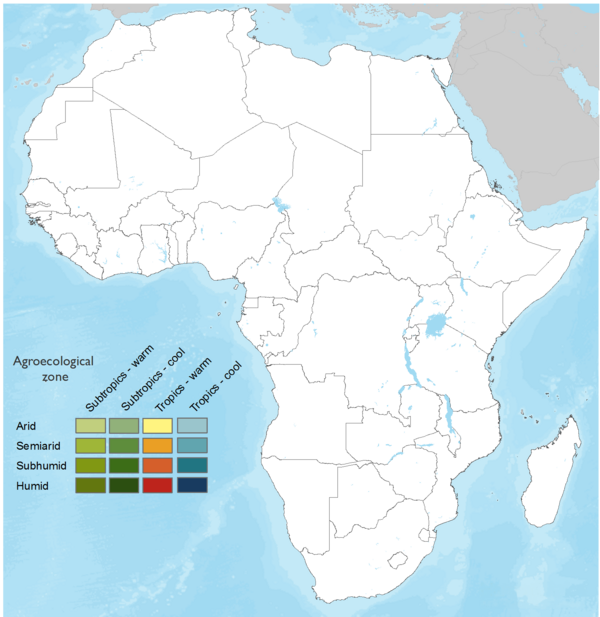

Agro-ecological zones where this technology can be used
AEZ Subtropic - warm Subtropic - cool Tropic - warm Tropic - cool
Arid – – – –
Semiarid – – – –
Subhumid – – – –
Humid – – –

Source: HarvestChoice/IFPRI 2009

The United Nations Sustainable Development Goals that are applicable to this technology.
Sustainable Development Goal 1: no poverty
Goal 1: no poverty

The technology supports women’s economic resilience and participation in the cassava value chain, which can strengthen their ability to participate in income-generating activities and manage productive assets.
Sustainable Development Goal 5: gender equality
Goal 5: gender equality

The technology directly addresses restrictive gender norms that limit women’s ability to make decisions about buying and selling productive assets without seeking permission from their husbands. It promotes more equal decision-making, shared responsibilities, and women’s economic autonomy.
Sustainable Development Goal 8: decent work and economic growth
Goal 8: decent work and economic growth

The technology supports women’s economic participation in the cassava agrifood system by strengthening their ability to make decisions about productive assets and participate more equitably in cassava production and processing.

The Gender-Transformative Dialogue Sessions are implemented through organized cassava-based groups and facilitated by trained facilitators. The Facilitator’s Guide organizes the approach into six modules and fifteen sessions, moving from understanding gender roles and norms to examining control over productive assets, promoting positive change, and developing practical commitments.

Key Recommendations

  • Train facilitators: Complete Training of Trainers (ToT) before conducting the Gender-Transformative Dialogue Sessions.
  • Work with organized groups: Use existing cassava-based groups as the main setting for implementation.
  • Ensure a safe environment: Create a respectful setting where participants feel comfortable sharing their views and experiences.
  • Use clear and relevant language: Adapt examples and explanations to participants’ local context and everyday experiences. 
  • Use participatory learning: Encourage active participation rather than relying only on presentations or explanations.
  • Allow time for action: Ensure that participants have an opportunity to turn their reflections into practical commitments.

Step 1: Prepare the facilitators
Conduct a Training of Trainers (ToT) to equip facilitators with the skills and good practices required to conduct the Gender-Transformative Dialogue Sessions.

Step 2: Organize the group
Work with an organized cassava-based group and identify the women and men who will participate. Explain the purpose of the Gender-Transformative Dialogue Sessions before starting the activities.

Step 3: Explore gender roles and household responsibilities
Guide participants to examine gender roles, household responsibilities, workload, and decision-making, and discuss how these affect women’s participation in the cassava agrifood system.

Step 4: Examine productive-asset control
Help participants identify major and minor productive assets and analyse who controls them, what influences this control, and how unequal control affects women’s autonomy. 

Step 5: Challenge restrictive attitudes
Use brainstorming, group discussion, critical reflection, practical exercises, and case studies to help participants examine and question gender norms and attitudes that restrict women’s decision-making. 

Step 6: Introduce positive examples and build support
Use positive masculinity approaches, men as allies, role models, gender-justice champions, and success stories to demonstrate possible changes in attitudes and relationships.

Step 7: Develop practical commitments
Support participants in identifying specific actions and SMART goals that promote more equitable household decision-making, shared responsibilities, and women’s autonomy over productive assets.

Last updated on Oct 20, 2026