
TAAT e-catalog
for
government
https://e-catalogs.taat-africa.org/gov/technologies/drought-resilient-urochloa-forage-for-year-round-livestock-feeding
Better grass. Better livestock.
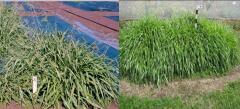
This technology is a set of improved Urochloa (syn. Brachiaria) forage grass cultivars for pasture improvement and year-round livestock feeding: Piatá, MG4, Basilisk, and Xaraes. Urochloa cultivars support national goals for food security and climate resilience. The grasses are perennial, providing 8–15 t per hectare of nutritious forage (8–15 % protein) each year. They tolerate poor and acidic soils and survive dry seasons thanks to deep roots. MG‑4 and Basilisk resist major pests, reducing pesticide use. Xaraes helps stabilise slopes and reduce erosion. Governments should ensure quality seed supply, provide extension services on land preparation, sowing and pest management and integrate Urochloa with soil conservation programmes.
This technology is pre-validated.
| Target groups | Positive impacts |
|---|---|
| Married women (25–55) with limited control over land (often responsible for finding/collecting forage) | • Save time when forage is planted close to home. • More milk and more cash (milk, hay, planting material). • Can gain more say in decisions when training includes gender topics. |
| Female-headed households (widowed/divorced; small land area; limited labor) | • More control over income from milk/hay sales. • Chance to earn from selling planting material. |
| Youth (18–35), women and men, with little land (often under-employed/seasonal migrants) | • New jobs and small businesses (planting material multiplication, cutting/baling/transport services, “model farms”). |
| Agro-pastoralists / pastoralists in arid areas (collective/customary land) | • Better feed security in the dry season (where systems are more settled). • Can support community fodder banks and land restoration if well managed. |
| Better-off commercial farmers (dairy hubs, ranches) | • Faster adoption (dedicated plots, irrigation, mechanization). • Can structure hay/seed markets and increase sales. |
| Landless farm workers (daily laborers, often women) | • More seasonal jobs (land preparation, planting, harvesting, baling, transport) as forage area expands. |
| Peri-urban small producers (zero-grazing) (very small plots; women often manage feeding/milk) | • Gains from planting on borders/hedges/corners. • Lower spending on purchased feed; steadier supply for animals. |
| Marginalized groups / remote areas (strong patrilineal land rules; weak access to services) | • If reached through women’s groups: entry into planting material/hay markets and better animal feeding. |
Urochloa (Brachiaria) forage grasses offer a practical solution to the feed shortages that reduce livestock productivity across Sub-Saharan Africa, especially in the dry season. They help farmers produce more fodder from the same land and keep livestock feeding more stable throughout the year.
To integrate this technology into your project, plan activities around:
Securing quality seed and organizing early distribution so farmers receive seed before the rains and can plant on time. Because the seed is small, the project should also ensure farmers use the right planting method and avoid deep sowing.
Setting up demonstration plots and training hubs in priority livestock areas to show the full cycle: land preparation, planting, first cut, and regular cutting/grazing.
Standardizing a simple pasture establishment package for extension agents and farmers, focusing on: fine seedbed preparation, planting at the start of rains (the factsheet notes planting can start after about 30 mm rainfall), and seed covering at 1–2 cm depth (not deeper).
Including weed control support during establishment, since early weed competition is a major risk; land preparation before rains and, where needed, herbicide control of tough weeds should be planned.
Budgeting for the key input costs that determine success, including land preparation, seed purchase and delivery logistics, and basic fertilizer support. The factsheet recommends phosphorus fertilizer (DAP) at planting and nitrogen fertilizer (CAN) after rains/after harvest to support regrowth.
Promoting hay making and fodder storage as a dry-season strategy, including training on harvest timing and simple storage practices, and linking producer groups to local buyers (dairy and fattening areas).
Planning harvesting and grazing management rules as part of extension: the first cut is around 80–90 days, then use rotation intervals (shorter in rainy season, longer in dry season) to maintain regrowth and year-round supply.
For best results, combine Urochloa adoption with good pasture management practices—timely planting, correct seed depth, early weed control, and fertilizer support—so farmers get strong establishment and reliable regrowth.
Implementing partners could collaborate with Alliance Bioversity International & CIAT (Tropical Forages program), national livestock and extension services, seed companies and seed regulators, cooperatives/dairy hubs, and women/youth groups to ensure inclusive access and sustained adoption.
Every USD invested returns USD 6.8 net income.
Open source / open access
| Project | Countries | Beneficiaries | Budget (USD) & duration | Key figures |
|---|---|---|---|---|
|
BREFOL -M Multinational - Building Climate Resilience for Food and Livelihoods Program (BREFOL) in the Horn of Africa |
|
|
169,80 million 2024–2030 |
|
|
P2-RSP2 Project 2 of the Food and Nutrition Insecurity Resilience Programme in the Sahel (P2-RSP2) – Gambia Component |
|
|
306.97 million 2025–2028 |
|
Figures in italic are from project plans and may change during implementation.
| Target groups | Positive impacts |
|---|---|
| Married women (25–55) with limited control over land (often responsible for finding/collecting forage) | • Save time when forage is planted close to home. • More milk and more cash (milk, hay, planting material). • Can gain more say in decisions when training includes gender topics. |
| Female-headed households (widowed/divorced; small land area; limited labor) | • More control over income from milk/hay sales. • Chance to earn from selling planting material. |
| Youth (18–35), women and men, with little land (often under-employed/seasonal migrants) | • New jobs and small businesses (planting material multiplication, cutting/baling/transport services, “model farms”). |
| Agro-pastoralists / pastoralists in arid areas (collective/customary land) | • Better feed security in the dry season (where systems are more settled). • Can support community fodder banks and land restoration if well managed. |
| Better-off commercial farmers (dairy hubs, ranches) | • Faster adoption (dedicated plots, irrigation, mechanization). • Can structure hay/seed markets and increase sales. |
| Landless farm workers (daily laborers, often women) | • More seasonal jobs (land preparation, planting, harvesting, baling, transport) as forage area expands. |
| Peri-urban small producers (zero-grazing) (very small plots; women often manage feeding/milk) | • Gains from planting on borders/hedges/corners. • Lower spending on purchased feed; steadier supply for animals. |
| Marginalized groups / remote areas (strong patrilineal land rules; weak access to services) | • If reached through women’s groups: entry into planting material/hay markets and better animal feeding. |
| Target groups | Unintended impacts | Mitigation measures |
|---|---|---|
| Married women with weak land rights | • Work shifts to women/girls (more cutting/transport/harvesting). • Household conflict if husband captures land or income. | • Add “forage + gender norms” training (joint decision-making, workload sharing). • Offer labor-saving services (cutting/chopping/baling). • Use traceable payments + clear benefit-sharing rules. |
| Female-headed households | • Risk of overload (limited labor). • Exclusion from finance/services; risk of local “land or water grabbing” (where irrigation is involved). | • Targeted vouchers for women/poor households with anti-capture rules. • Small seed/planting-material packs adapted to their capacity. • Formal land-use agreements where needed. |
| Youth with little land | • Benefits captured by elders who control resources. • Risk of being pushed into hard/unsafe work. | • Youth-led service businesses (cutting/baling/transport) with fair contracts. • Transparent targeting (public lists/complaints system). • Safety training and equipment where labor is hired. |
| Pastoralists / agro-pastoralists (arid zones) | • Risk of privatizing commons (“enclosures”) and tensions with mobility. • Unequal access to water/land. | • Community rules for access/management + local agreements on land use. • Plan seed availability suited to the zone + local governance for fodder banks. |
| Commercial farmers | • Capture of subsidies/certified seed. • Land pressure and buyers dominating hay prices (hurting smallholders). | • Use targeted vouchers with anti-capture clauses. • Structure hay markets with transparent pricing and traceable payments. • Strengthen cooperative inclusion rules. |
| Landless workers | • Harder work without protection; wage gaps; unstable jobs. • Possible herbicide exposure if chemical land prep increases. | • Require PPE + safety training + fair wage standards + contracts for hired labor. • Monitor incidents and pay gaps. |
| Remote / marginalized groups | • Exclusion of women through inheritance/land rules. • Misinformation and spread of poor-quality seed through informal channels. | • Distribute quality planting material through women’s groups + mixed channels. • Coordinate with regulators to improve certification/quality and availability. |
| Target groups | Barriers to adoption | Mitigation measures |
|---|---|---|
| Married women with weak land rights | • Limited land and limited decision power. • Low participation in cooperatives (less information/seed/training). • Work is physically demanding; irregular access to quality seed/planting material. | • Small seed/planting-material packs via women’s groups. • Gender-smart training schedules + local languages. • Light mechanization services (cutting/chopping/baling) targeted to women users. |
| Female-headed households | • Limited credit and mechanization; upfront costs. • Labor needed for establishment/harvest. • Market access for bales/transport. | • Targeted vouchers + gradual entry (“small packs”). • Connect to service providers (youth contractors) for cutting/baling/transport. • Support market links for hay/planting material. |
| Youth with little land | • Under-represented in cooperatives (less inputs/training). • Limited land access. • Low capital for equipment and hay stocks. | • Create youth service-business pathways (baling/transport/chopping). • Lower entry cost with targeted vouchers and cooperative inclusion measures. |
| Pastoralists / agro-pastoralists (arid zones) | • Suitable seed not available. • Need collective rules for access/management. • Weak extension/vet services; distant markets. | • Work with local authorities on collective management rules + land-use agreements. • Improve seed availability and certification pathways. |
| Landless workers | • They don’t decide adoption (depends on landowners). • Little access to training and safety equipment; weak contracts. | • Include labor standards in programs: PPE, safety training, fair pay scales, written contracts. |
| Peri-urban zero-grazing small producers | • Very limited land. • Need quality seed/planting material. • Need practical advice (planting density, cutting, conservation). | • Promote hedge/border planting options + tailored coaching. • Provide small packs + close-to-home demos through groups/coops. |
| Remote / marginalized groups | • Isolation (markets/training), weak extension. • Dependence on informal seed channels; transport costs. | • Seed/planting-material distribution through structured channels + women’s groups. • Strengthen certification/quality and reduce bottlenecks. |
|
Cost of the investment Sum of all fixed and operational expenses.. |
USD 2,616 Per hectare over 10 years |
|---|---|
|
Gross revenue Sum of all income before subtracting costs. |
USD 20,400 Per hectare over 10 years |
|
Net income Gross revenue minus total cost. |
USD 17,783 Per hectare over 10 years |
|
Return on investment Percentage of income earned for each dollar invested, calculated as: (income ÷ cost of investment) × 100 |
680 % Over 10 years |
| Country | Testing ongoing | Tested | Adopted |
|---|---|---|---|
| Kenya | –No ongoing testing | Tested | –Not adopted |
This technology can be used in the colored agro-ecological zones. Any zones shown in white are not suitable for this technology.
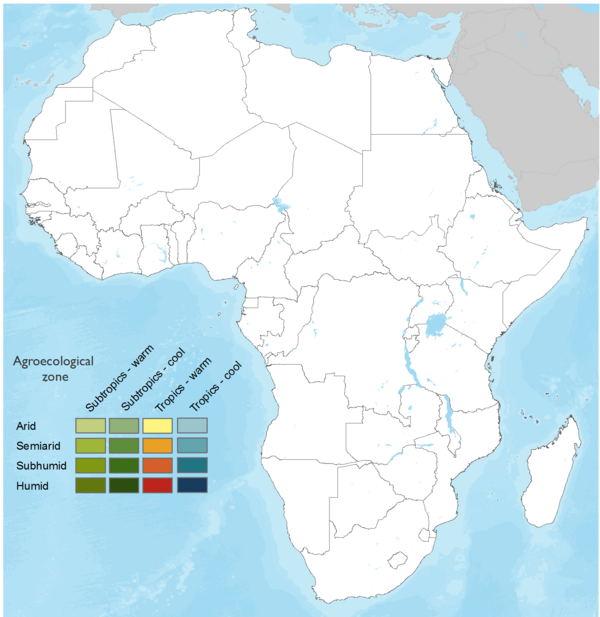






| AEZ | Subtropic - warm | Subtropic - cool | Tropic - warm | Tropic - cool |
|---|---|---|---|---|
| Arid | – | – | – | – |
| Semiarid | – | – | ||
| Subhumid | – | – | ||
| Humid | – | – |
Source: HarvestChoice/IFPRI 2009
The United Nations Sustainable Development Goals that are applicable to this technology.
Better forage means farmers can produce and sell more milk/meat and also earn from selling forage planting material and hay, which can raise household income.
A more reliable feed supply helps farmers keep animals productive through the year, supporting steady availability of nutritious animal-source foods (milk/meat) for households and markets.
Creates opportunities for women and youth to participate in forage seed and forage value chains, while also reducing labor demands, especially for women.

Increases animal stocking rates and reduces environmental footprint per unit product (emission reductions, land sparing, carbon sequestration)
1. Site selection and land preparation
Choose a well-drained field and prepare a clean, fine seedbed (the seeds are small). Do land preparation before the rains to make weeding easier. If the field has tough weeds (e.g., couch grass), herbicide spraying is recommended. Plough to about 25 cm and harrow to obtain a fine tilth; avoid sloping or uneven land where possible.
2. Planting (start of the rainy season)
Start planting when rains have started well (the factsheet notes sowing can start after about 30 mm of rainfall).
3. Seeding rate and method
Row planting: plant in rows 40–50 cm apart, using about 8 kg of seed/ha.
Broadcast sowing: use 10–12 kg of seed/ha.
4. Cover the seed lightly (do not bury deep)
After sowing, cover the seed with a harrow. On small plots, use tree branches or large brooms to lightly cover the seed. Keep seed depth to 1–2 cm (do not exceed 2 cm).
5. Weed control during establishment
Keep the plot free of weeds during the first 6–8 weeks so the grass can establish well. (Field practice from your draft, maintained as requested.)
6. Fertilisation / manure
At planting, apply a phosphorus fertilizer (DAP) to support root development. Later, apply CAN at 100 kg/ha per year, preferably after rains and ideally after harvesting when soil is wet to support regrowth. In poor soils, farmers can also top up with manure.
7. First cut or first grazing
First use is around 80–90 days (about 3 months) after planting.
8. Regular harvesting / grazing schedule (leave stubble)
After establishment, harvest or graze in rotation. The factsheet suggests about 25–45 days during the rainy season and about 60–70 days during the dry season. When cutting or grazing, leave some stubble to allow quick regrowth.
Last updated on Sep 14, 2026
This technology can be used in the colored agro-ecological zones.








Drought-resilient Urochloa forage for year-round livestock feeding
https://e-catalogs.taat-africa.org/gov/technologies/drought-resilient-urochloa-forage-for-year-round-livestock-feeding
Last updated on 14 September 2026, printed on Oct 11, 2026
Enquiries e-catalogs@taat.africa