Logo
TAAT e-catalog for government
https://e-catalogs.taat-africa.org/gov/technologies/cram-varieties-high-yielding-climate-resilient-upland-rice-varieties-for-africa
Request information View pitch brochure

CRAM varieties: High Yielding Climate Resilient Upland Rice Varieties for Africa

Climate resilient CRAM varieties for enhanced rice productivity for African farmers

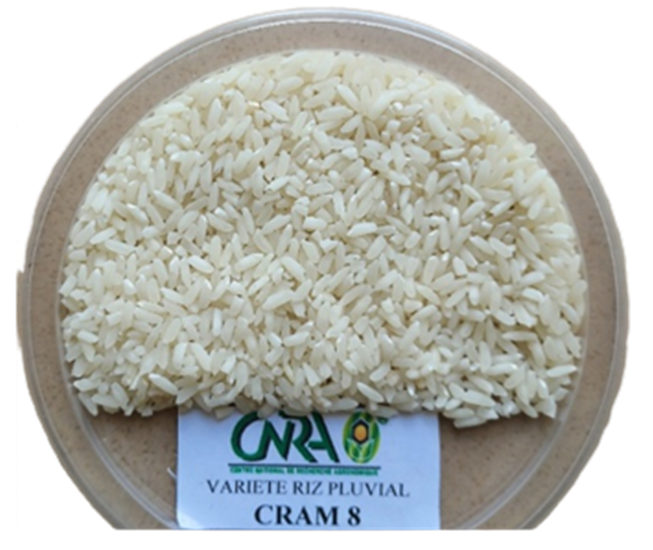
CRAM (Climate Resilient Upland Rice Varieties for Africa) are early-maturing, high-yielding rice varieties developed for rainfed upland production, including sloping fields and areas receiving around 800 mm of annual rainfall. Their 101–104-day growth cycle enables farmers to escape late-season drought and produce food within a relatively short period, while yield potential of up to 5.0 t/ha can contribute to higher domestic rice production. Their resistance to blast and brown spot can reduce reliance on chemical pesticides, while their adaptation to rainfed conditions reduces dependence on flooded irrigation. By increasing productivity in existing upland areas, CRAM varieties can support food security, rice import substitution, climate adaptation, and sustainable agricultural intensification. Their rainfed upland production system can also contribute to lower methane emissions than continuously flooded rice systems.
2

This technology is pre-validated.

9•8

Scaling readiness: idea maturity 9/9; level of use 8/9

Positive impacts: 9

Intersectional group

Positive impacts

Low-income/resource-constrained farmers

  • Lower production risk: Drought and disease tolerance can help stabilise yields.
  • Suitable for rainfed systems: Farmers do not need continuous irrigation to produce CRAM.
  • Improved food and income: Yield potential of up to 5 t/ha can increase household rice availability and marketable surplus.

Farmers in climate-vulnerable areas

  • Better drought adaptation: Short duration reduces exposure to late-season dry spells.
  • More reliable production: Disease resistance and good crop stability reduce key production risks.
  • Sustainable intensification: Higher productivity can reduce pressure to expand cultivation into natural areas.

Women and youth in seed businesses

  • Business opportunity: Seed multiplication offers attractive commercial potential.
  • Employment: Opportunities exist in seed production, processing, packaging and distribution.
  • Market participation: Growing access to quality CRAM seed can create new roles in local seed value chains.
More...

Climate adaptability: Highly adaptable

Drought tolerance, short duration and disease resistance support production under variable rainfall and moderate climate stress.

Farmer climate change readiness: Significant improvement

Helps farmers reduce exposure to drought and erratic rainfall through adapted varieties and more reliable harvests.

Carbon footprint: Much less carbon released

Upland rainfed systems generally have much lower methane emissions than continuously flooded rice, but CRAM-specific emission reductions are unquantified.

Water use: Much less water used

Well suited to rainfed upland production, reducing reliance on irrigation, although specific water-use efficiency has not been demonstrated.

Biodiversity: Not verified

Disease resistance and higher productivity may reduce pressure on ecosystems and land expansion, but benefits depend on management.

Environmental health: Not verified

Disease resistance may reduce chemical use and reliable yields may reduce land-expansion pressure, depending on management.

Soil quality: Not yet estimated

CRAM does not directly improve soil fertility; soil health requires complementary fertility and residue-management practices.

Problem

  • Low and unstable rice production: Drought and increasingly variable rainfall can cause moisture stress and yield losses in rainfed upland rice systems, constraining domestic rice supply.
  • Climate vulnerability of rainfed agriculture: Short and unpredictable rainfall seasons create a need for varieties capable of maintaining production under water-limited conditions.
  • Disease pressure: Blast and brown spot can undermine rice productivity and increase farmers' reliance on chemical crop protection.
  • Limited adaptation to short growing seasons: Varieties with long growth cycles may not mature reliably within increasingly variable rainfall windows.
  • Production and harvest losses: Lodging and grain shattering can reduce effective yields and make harvesting more difficult and costly.
  • Weak consumer acceptance of some local rice: Poor grain and cooking quality can limit demand for domestically produced rice, reducing the potential for strengthening local rice markets and import substitution.

Solution

  • Increased rice productivity: High yield potential of up to 5.0 t/ha can increase domestic rice production and contribute to reducing import dependence.
  • Climate-resilient production: Good drought tolerance and a 101–104-day growth cycle help farmers manage water stress and escape late-season droughts.
  • Adaptation to rainfed areas: CRAM is suited to upland and sloping fields, including areas receiving around 800 mm of annual rainfall, reducing dependence on flooded irrigation.
  • Reduced production and harvest risks: Resistance to blast and brown spot, together with good lodging and shattering resistance, helps stabilise production under challenging conditions.
  • Sustainable intensification: High productivity on suitable existing upland farmland can support increased food production without requiring proportional expansion into forests or other natural ecosystems.
  • Reduced chemical dependence: Genetic resistance to major diseases can reduce the need for chemical crop protection and associated environmental pressures.
  • Lower methane emissions: As a rainfed upland rice technology, CRAM avoids continuous flooding and can contribute to lower methane emissions compared with conventional continuously flooded rice systems.
  • Improved food quality and acceptance: Good grain and cooking quality, including aroma in selected varieties, supports consumer acceptance and the broader development of domestic rice markets.

Key points to design your project

By contributing to SDGs 1, 2, 13 and 15, CRAM offers governments an opportunity to address interconnected challenges of poverty, food insecurity, climate vulnerability and sustainable land management through a single agricultural investment. Its combination of high yield potential, early maturity, drought tolerance and disease resistance can strengthen the resilience and productivity of rainfed rice systems while supporting more sustainable use of agricultural land.

To translate these benefits into national-level impact, governments should consider the following key elements when integrating CRAM into agricultural programmes:

  • Define the programme objective: Focus on increasing domestic rice production, strengthening climate resilience and supporting sustainable intensification in suitable rainfed areas.
  • Target the right production areas: Prioritise well-drained upland and sloping fields, particularly sandy loam and loamy soils in areas with around 800 mm or more annual rainfall. Avoid excessively sandy or heavy, compacted clay soils.
  • Reach the most relevant farmers: Prioritise smallholder and rainfed rice farmers exposed to drought, rainfall variability and disease pressure, particularly those seeking shorter-duration varieties.
  • Select varieties according to local needs: CRAM varieties mature in 101–104 days, with specific varieties offering ultra-early maturity or desirable traits such as aroma. Variety selection should therefore reflect local rainfall patterns, production objectives and market preferences.
  • Build climate resilience into implementation: Promote CRAM as part of climate adaptation strategies, using its drought tolerance and short production cycle to reduce exposure to late-season dry spells and unpredictable rainfall.
  • Support sustainable intensification: Combine improved varieties with appropriate soil fertility management, timely planting, weed management and integrated pest management to increase productivity on existing farmland and reduce pressure for agricultural expansion.
  • Strengthen the seed delivery system: Facilitate access to quality seed through national seed systems, private multipliers and farmer organisations. 11.5 tonnes of G4 foundation seed are available through CNRA for CRAM 1, 2, 3, 4 and 6, providing a basis for further multiplication.
  • Build partnerships for scale: Coordinate AfricaRice, CNRA, seed certification authorities, extension services, private seed multipliers, cooperatives and other value-chain actors to ensure quality seed production, dissemination and farmer support.
  • Measure development outcomes: Track indicators such as area under CRAM, adoption, yields, household food availability, farmer income, women’s participation and resilience to rainfall variability to demonstrate programme impact.

By linking climate-resilient varieties with quality seed systems, appropriate targeting and coordinated national support, CRAM can move beyond individual farmer benefits to contribute to broader national goals of food security, climate adaptation, sustainable land use and reduced poverty.

Cost vs. revenue

Data reliability of this estimate:: 75 %

Return on investment 30 %

Every USD invested returns USD 0.3 net income.

Detailed financial information ›

1.78 USD per kg

Certified Seed Purchase

3,220.00 USD per ha

Official Variety Certification & Inspection

3.57 USD per kg

Foundation Seed Procurement

4,000 kg per ha

Expected Seed Yield

IP

Open source / open access

CRAM varieties: High Yielding Climate Resilient Upland Rice Varieties for Africa

Variety

Interspecific Name / Pedigree

Sowing-Maturity Cycle (Days)

Yield Potential (t/ha)

Milling Recovery (%)

Head Rice Yield (%)

1000-Grain Weight (g)

Plant Height (cm)

Amylose Content (%)

Aromatic

CRAM 1

ARICA 14

103

4.8

73%

56%

25.29

114

19%

No

CRAM 2

ARICA 15

102

5.0

72%

59%

26.09

115

19%

No

CRAM 3

ARCC3Fa3L10P1-1-B-1

104

4.9

75%

57%

27.07

121

19%

No

CRAM 4

ART15-16-12-3-1-B-1-B-3-1

101

4.6

66%

50%

25.00

121

19%

Yes

CRAM 6

ART35-49-1-7D-1

103

5.0

71%

65%

22.79

123

19%

Yes

CRAM 8

ART34-120-1-2-B-1

103

5.0

73%

62%

38.11

123

19%

Yes

CRAM 10

BRS PRIMAVERA / WAB638-1

102

4.0

72%

68%

37.00

112

19%

N/A

CRAM 12

ART35-272-1-2-B-1

102

5.0

72%

68%

37.78

119

18%

Yes

Scaling Readiness describes how complete a technology\’s development is and its ability to be scaled. It produces a score that measures a technology\’s readiness along two axes: the level of maturity of the idea itself, and the level to which the technology has been used so far.

Each axis goes from 0 to 9 where 9 is the “ready-to-scale” status. For each technology profile in the e-catalogs we have documented the scaling readiness status from evidence given by the technology providers. The e-catalogs only showcase technologies for which the scaling readiness score is at least 8 for maturity of the idea and 7 for the level of use.

The graph below represents visually the scaling readiness status for this technology, you can see the label of each level by hovering your mouse cursor on the number.

Read more about scaling readiness ›

Scaling readiness score of this technology

Maturity of the idea 9 out of 9

Uncontrolled environment: validated

Level of use 9 out of 9

Used by some intended users, in the real world

Maturity of the idea Level of use
9
8
7
6
5
4
3
2
1
1 2 3 4 5 6 7 8 9

Positive impact 9

Intersectional group

Positive impacts

Low-income/resource-constrained farmers

  • Lower production risk: Drought and disease tolerance can help stabilise yields.
  • Suitable for rainfed systems: Farmers do not need continuous irrigation to produce CRAM.
  • Improved food and income: Yield potential of up to 5 t/ha can increase household rice availability and marketable surplus.

Farmers in climate-vulnerable areas

  • Better drought adaptation: Short duration reduces exposure to late-season dry spells.
  • More reliable production: Disease resistance and good crop stability reduce key production risks.
  • Sustainable intensification: Higher productivity can reduce pressure to expand cultivation into natural areas.

Women and youth in seed businesses

  • Business opportunity: Seed multiplication offers attractive commercial potential.
  • Employment: Opportunities exist in seed production, processing, packaging and distribution.
  • Market participation: Growing access to quality CRAM seed can create new roles in local seed value chains.

Unintended impact 9

Intersectional group

Potential unintended impacts

Mitigation measures

Low-income/resource-constrained farmers

  • Input pressure: Improved varieties may encourage greater fertiliser use, increasing production costs.
  • Market dependency: Commercial seed may create recurring seed-purchase costs.
  • Exclusion of the poorest: Farmers unable to purchase quality seed may benefit less.
  • Promote efficient input use: Combine CRAM with locally appropriate soil fertility practices.
  • Strengthen local seed systems: Support affordable and reliable local seed multiplication.
  • Use targeted support: Include vulnerable farmers in seed distribution and demonstration schemes.

Climate-vulnerable farmers

  • Production concentration: Over-reliance on CRAM could increase vulnerability if a variety is poorly matched to local conditions.
  • Extreme climate events: Drought tolerance does not eliminate risk under severe climatic stress.
  • Environmental pressure: Higher profitability could encourage expansion into marginal or natural areas.
  • Maintain varietal diversity: Promote several CRAM varieties and other locally adapted crops/varieties.
  • Combine with climate-smart practices: Integrate soil, water and risk-management measures.
  • Promote sustainable land-use planning: Prioritise intensification on suitable existing farmland.

Women and youth in seed businesses

  • Unequal access to business opportunities: Established businesses may capture most seed-market opportunities.
  • Limited finance: Women and youth may struggle to finance multiplication and certification costs.
  • Market barriers: Limited networks may restrict access to buyers and distribution channels.
  • Target inclusive business support: Facilitate access to finance, training and certification support.
  • Use inclusive contracting: Encourage seed companies to work with women- and youth-led enterprises.
  • Strengthen market linkages: Connect emerging businesses with cooperatives, agro-dealers and institutional buyers.

Barriers 9

Intersectional group

Adoption barriers

Mitigation measures

Low-income/resource-constrained farmers


  • Cost: Quality seed and complementary inputs may be unaffordable.
  • Access to services: Limited access to credit, extension and technical support.
  • Adoption risk: Uncertainty about local performance and market demand discourages investment.


  • Demonstration plots: Allow farmers to observe CRAM performance locally before adoption.
  • Reduce entry costs: Support community-based seed multiplication and targeted starter seed packages.
  • Improve access to finance and markets: Link farmers with savings groups, credit providers and buyers.

Climate-vulnerable farmers


  • Agroecological uncertainty: Farmers may be unsure which CRAM variety is best suited to their conditions.
  • Climate information: Limited access to reliable weather and extension information.
  • Climate shocks: Severe droughts or other extreme events can still threaten production.


  • Agroecological targeting: Match varieties to local rainfall, soils and production conditions.
  • Strengthen climate information: Link farmers with seasonal forecasts and extension advice.
  • Promote integrated resilience: Combine CRAM with soil fertility, water and crop-management practices.

Women and youth seed entrepreneurs


  • Investment costs: Foundation seed, certification and multiplication require upfront capital.
  • Technical capacity: Limited knowledge of seed production and quality standards.
  • Market access: Difficulty accessing established distribution and buyer networks.


  • Business and technical training: Build capacity in seed production, quality control and marketing.
  • Facilitate finance: Link entrepreneurs to agricultural finance and business-development support.
  • Build market partnerships: Connect them with certification authorities, agro-dealers, cooperatives and larger seed companies.

Cost of the investment
Sum of all fixed and operational expenses..
USD 1,012
USD per hectare
Gross revenue
Sum of all income before subtracting costs.
USD 1,320
USD per hectare
Net income
Gross revenue minus total cost.
USD 308
USD per hectare
Return on investment
Percentage of income earned for each dollar invested, calculated as:
(income ÷ cost of investment) × 100
30 %
per hectare

References:

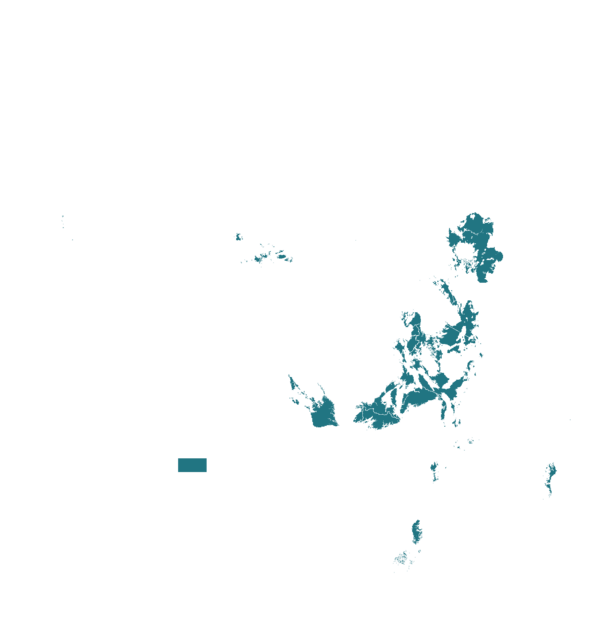
Countries with a green colour
Tested & adopted
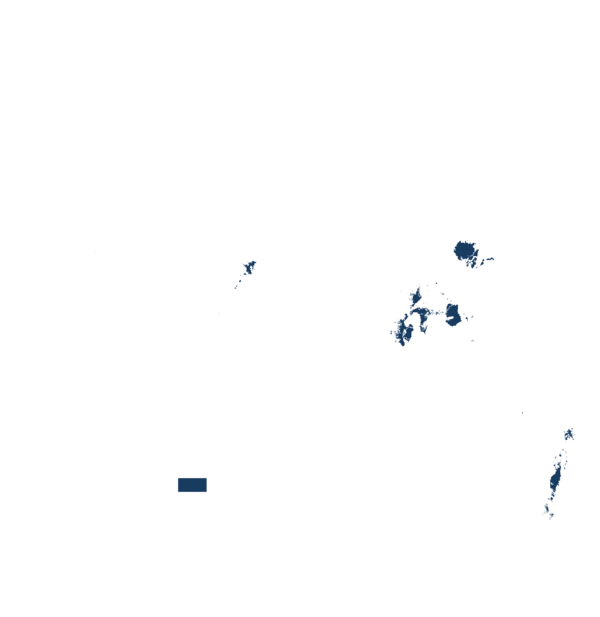
Countries with a bright green colour
Adopted
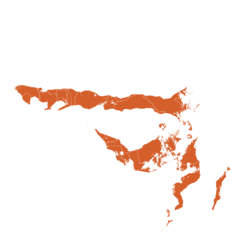
Countries with a yellow colour
Tested
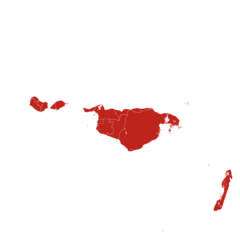
Countries with a blue colour
Testing ongoing
Egypt Equatorial Guinea Ethiopia Algeria Angola Benin Botswana Burundi Burkina Faso Democratic Republic of the Congo Djibouti Côte d’Ivoire Eritrea Gabon Gambia Ghana Guinea Guinea-Bissau Cameroon Kenya Libya Liberia Madagascar Mali Malawi Morocco Mauritania Mozambique Namibia Niger Nigeria Republic of the Congo Rwanda Zambia Senegal Sierra Leone Zimbabwe Somalia South Sudan Sudan South Africa Eswatini Tanzania Togo Tunisia Chad Uganda Western Sahara Central African Republic Lesotho
Countries where the technology is being tested or has been tested and adopted
Country Testing ongoing Tested Adopted
Côte d’Ivoire No ongoing testing Not tested Adopted

This technology can be used in the colored agro-ecological zones. Any zones shown in white are not suitable for this technology.
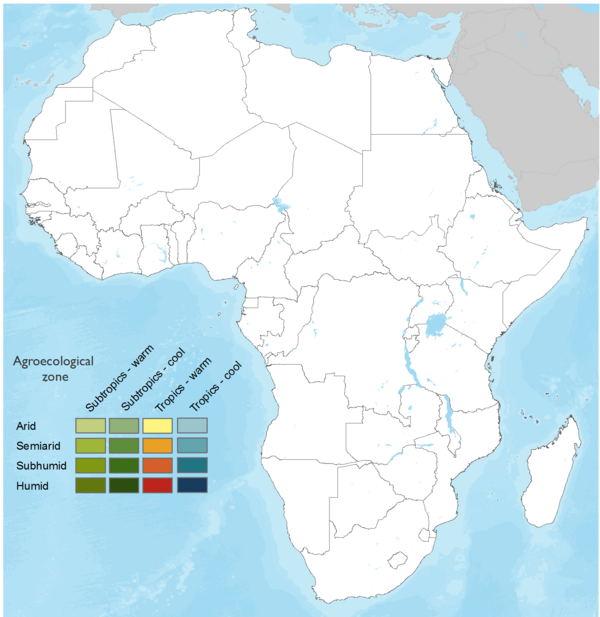
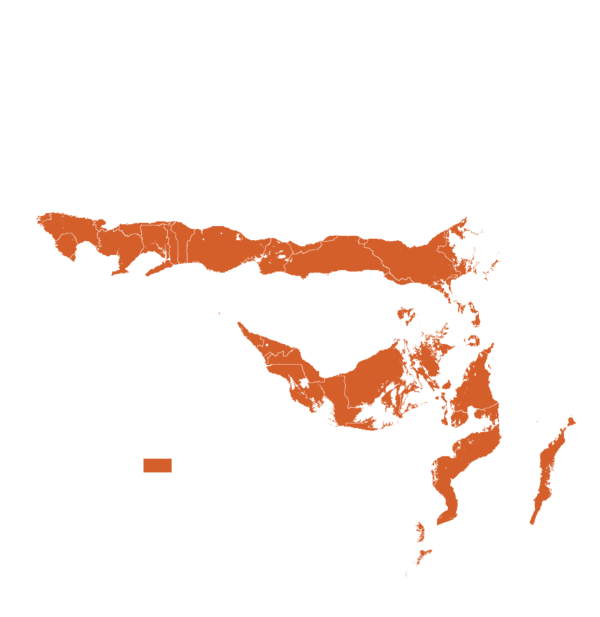
Agro-ecological zones where this technology can be used
AEZ Subtropic - warm Subtropic - cool Tropic - warm Tropic - cool
Arid
Semiarid
Subhumid
Humid

Source: HarvestChoice/IFPRI 2009

The United Nations Sustainable Development Goals that are applicable to this technology.
Sustainable Development Goal 1: no poverty
Goal 1: no poverty

Higher and more reliable yields, early maturity and stress tolerance can reduce production risks and strengthen smallholder incomes.
Sustainable Development Goal 2: zero hunger
Goal 2: zero hunger

More reliable rice harvests, good yield potential and early maturity can improve household food security and local rice supply.

Sustainable Development Goal 13: climate action
Goal 13: climate action

Drought tolerance and short duration strengthen farmers’ adaptation to erratic rainfall and climate stress.

1. Select the right variety:

Choose the variety according to local agroecological conditions and production objectives. CRAM 4, 2, 10 and 12 are among the earliest varieties, while CRAM 4, 6, 8 and 12 offer desirable aromatic qualities.

2. Choose the right field:

Plant CRAM in well-drained upland or sloping fields, preferably with sandy loam or loamy soils. Avoid excessively sandy or heavy, compacted clay soils that can limit crop performance.

3. Prepare the field:

Establish a clean, loose seedbed by clearing and ploughing the field. Deep-plough to 20–25 cm, followed by a second ploughing shortly before sowing.

4. Plant at the right time:

Sow directly at the onset of reliable rains to ensure good crop establishment. Use 40–60 kg of seed/ha, with 20 × 20 cm spacing and a sowing depth of 2–3 cm.

5. Fertilise and control weeds:

Apply 200 kg/ha of NPK during the second ploughing. Maintain good weed control, particularly during the critical first 30–40 days. Apply 100 kg/ha of urea in two doses at 21 days and 55–60 days after sowing, ensuring the field is weed-free before each application.

6. Monitor the crop:

Regular field monitoring is important to detect insects, rodents, and birds early. Pay particular attention from the milky stage through maturity, when grain losses can increase.

7. Harvest at maturity:

Harvest when approximately two-thirds of the panicle has turned straw-coloured or when grain moisture reaches 22–25%. Depending on the variety, maturity occurs around 101–104 days after sowing.

8. Dry and store correctly:

Clean and thresh the paddy carefully, then dry it to approximately 14% moisture. Store in clean bags in a dry, well-ventilated facility to maintain grain quality and prevent spoilage.

Downloads

Last updated on Sep 7, 2026