59 technologies























Transforming gender norms to advance women’s leadership
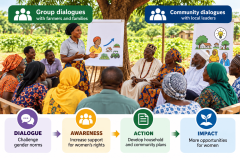
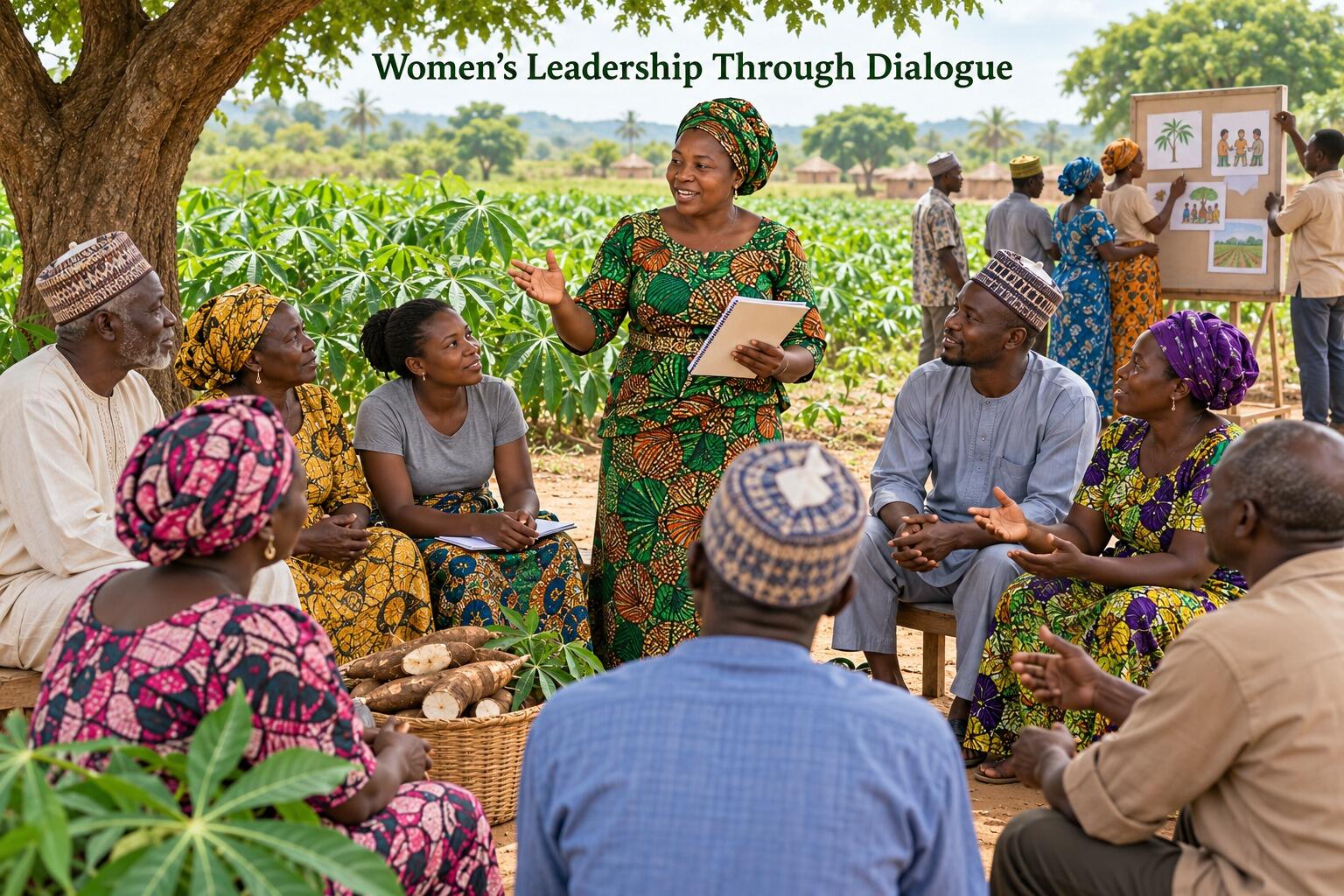
The gender-transformative dialogue approach addresses norms affecting women’s leadership through coordinated engagement at group and community levels.
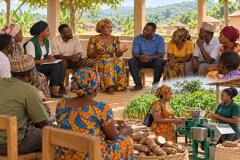
An eight-session curriculum uses facilitated discussions, critical reflection, brainstorming, participatory activities and male engagement with women and men in agricultural groups. Participants examine attitudes, harmful masculinities and unequal gender relations that restrict women’s participation in leadership and identify practical actions for change.
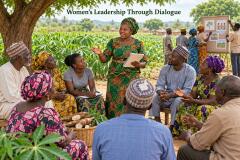
Community dialogues extend the process to traditional rulers and chiefs, religious and youth leaders, family heads, women leaders, farmer and market leaders, group leaders and other relevant local stakeholders. Drama skits and case studies support collective reflection on barriers to women’s leadership and the development of locally relevant strategies and community action plans.
This two-level structure addresses norms within organized agricultural groups alongside the community environment that influences women’s participation in leadership.
This technology is not yet validated.
| target group | Positive impacts |
|---|---|
| Young women smallholder farmers with disabilities |
|
| Young women smallholder farmers from socially marginalized or minority groups |
|
| Young women with disabilities from socially marginalized or minority groups |
|
| Women smallholder farmers with disabilities from socially marginalized or minority groups |
|
Climate adaptability: Highly adaptable
As a social innovation, the approach is not dependent on specific climatic or weather conditions and can be adapted for implementation across diverse climatic contexts.
Farmer climate change readiness: No improvement
The approach does not directly strengthen farmers’ capacity to anticipate, prepare for, or respond to climate-related risks. Its primary focus is transforming gender norms and strengthening women’s participation in leadership.
Integrates into gender-responsive agriculture, rural development, women’s empowerment and agricultural extension programmes seeking to strengthen women’s participation and representation in leadership.
Open source / open access
Scaling Readiness describes how complete a technology's development is and its ability to be scaled. It produces a score that measures a technology's readiness along two axes: the level of maturity of the idea itself, and the level to which the technology has been used so far.
Each axis goes from 0 to 9 where 9 is the “ready-to-scale” status. For each technology profile in the e-catalogs we have documented the scaling readiness status from evidence given by the technology providers. The e-catalogs only showcase technologies for which the scaling readiness score is at least 8 for maturity of the idea and 7 for the level of use.
The graph below represents visually the scaling readiness status for this technology, you can see the label of each level by hovering your mouse cursor on the number.
Semi-controlled environment: testing
By some projects connected to technology providers
| Maturity of the idea | Level of use | |||||||||
| 9 | ||||||||||
| 8 | ||||||||||
| 7 | ||||||||||
| 6 | ||||||||||
| 5 | ||||||||||
| 4 | ||||||||||
| 3 | ||||||||||
| 2 | ||||||||||
| 1 | ||||||||||
| 1 | 2 | 3 | 4 | 5 | 6 | 7 | 8 | 9 | ||
| target group | Positive impacts |
|---|---|
| Young women smallholder farmers with disabilities |
|
| Young women smallholder farmers from socially marginalized or minority groups |
|
| Young women with disabilities from socially marginalized or minority groups |
|
| Women smallholder farmers with disabilities from socially marginalized or minority groups |
|
| Target group | Unintended impacts | Mitigation measures |
|---|---|---|
| Young women smallholder farmers with disabilities |
|
|
| Young women smallholder farmers from socially marginalized or minority groups |
|
|
| Young women with disabilities from socially marginalized or minority groups |
|
|
| Women smallholder farmers with disabilities from socially marginalized or minority groups |
|
|
| Target group | Adoption barriers | Mitigation measures |
|---|---|---|
| Young women smallholder farmers with disabilities |
|
|
| Young women smallholder farmers from socially marginalized or minority groups |
|
|
| Young women with disabilities from socially marginalized or minority groups |
|
|
| Women smallholder farmers with disabilities from socially marginalized or minority groups |
|
|
| Country | Testing ongoing | Tested | Adopted |
|---|---|---|---|
| Nigeria | Testing ongoing | –Not tested | –Not adopted |
This technology can be used in the colored agro-ecological zones. Any zones shown in white are not suitable for this technology.
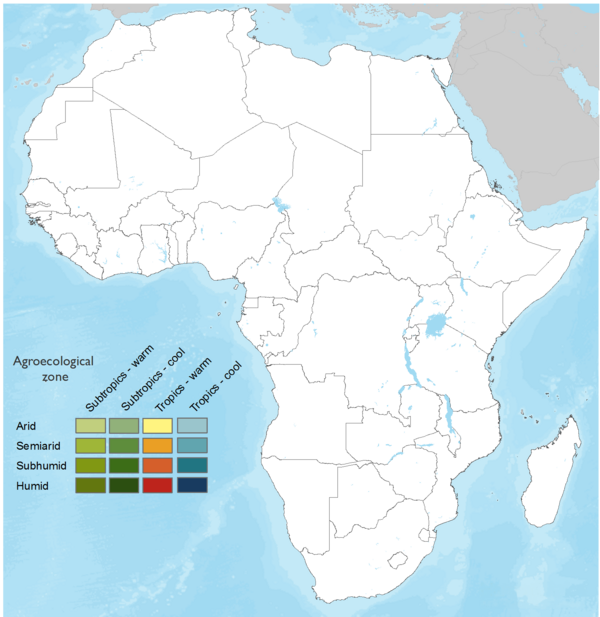


| AEZ | Subtropic - warm | Subtropic - cool | Tropic - warm | Tropic - cool |
|---|---|---|---|---|
| Arid | – | – | – | – |
| Semiarid | – | – | – | – |
| Subhumid | – | – | – | |
| Humid | – | – | – |
Source: HarvestChoice/IFPRI 2009
The United Nations Sustainable Development Goals that are applicable to this technology.
The participatory dialogue sessions provide learning opportunities for women and men to strengthen their understanding of gender norms, unequal gender relations and women’s leadership, and to identify practical actions for more equitable participation.
The approach addresses restrictive gender norms that limit women’s participation in leadership and decision-making, helping expand their opportunities to take up leadership roles and strengthen their influence in group decisions.
Step 1 – Prepare the dialogue sessions: Use the facilitator guides to plan the group and community dialogues and identify the participants and stakeholders to engage.
Step 2 – Conduct group dialogues: Deliver the eight-session curriculum with women and men using facilitated discussions, critical reflection, brainstorming and participatory group activities.
Step 3 – Examine leadership norms: Support participants in identifying and reflecting on gender norms, attitudes, harmful masculinities and unequal gender relations that restrict women’s leadership.
Step 4 – Conduct community dialogues: Engage traditional, religious and youth leaders, family heads, women leaders, farmer and market leaders, group leaders and other relevant stakeholders using facilitated discussions, drama skits and case studies.
Step 5 – Develop actions for change: Identify practical actions and develop group and community strategies that create greater opportunities for women to take up and participate effectively in leadership positions.
Last updated on Oct 20, 2026
This technology can be used in the colored agro-ecological zones.




Gender-Transformative Dialogues for Women’s Leadership in Cassava Groups
https://e-catalogs.taat-africa.org/gov/technologies/gender-transformative-dialogues-for-womens-leadership-in-cassava-groups/embed
Last updated on 20 October 2026, printed on Oct 23, 2026
Enquiries e-catalogs@taat.africa