59 technologies













Challenging gender norms, empowering women to own and control productive assets
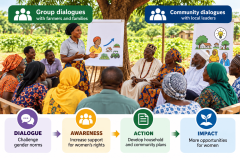
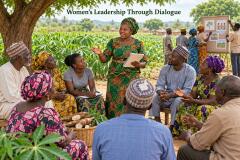
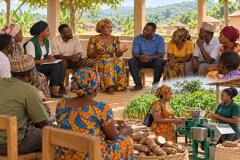
Gender Dialogues for Women’s Land and Asset Rights is a gender-transformative social innovation designed to address the underlying social norms and structural barriers that limit women’s ownership and control of land and other productive assets in the cassava agrifood system. The intervention combines two mutually reinforcing components. Group dialogue sessions engage cassava-based farmer groups and their families in critical reflection, brainstorming, discussion, and practical exercises to challenge restrictive gender attitudes, strengthen men’s support for women’s land and asset rights, and encourage equitable household decision-making. Community dialogue sessions engage traditional rulers, chiefs, religious and youth leaders, family heads, women leaders, and farmer and market leaders to identify community-level barriers and develop action plans to expand women’s access to productive resources.
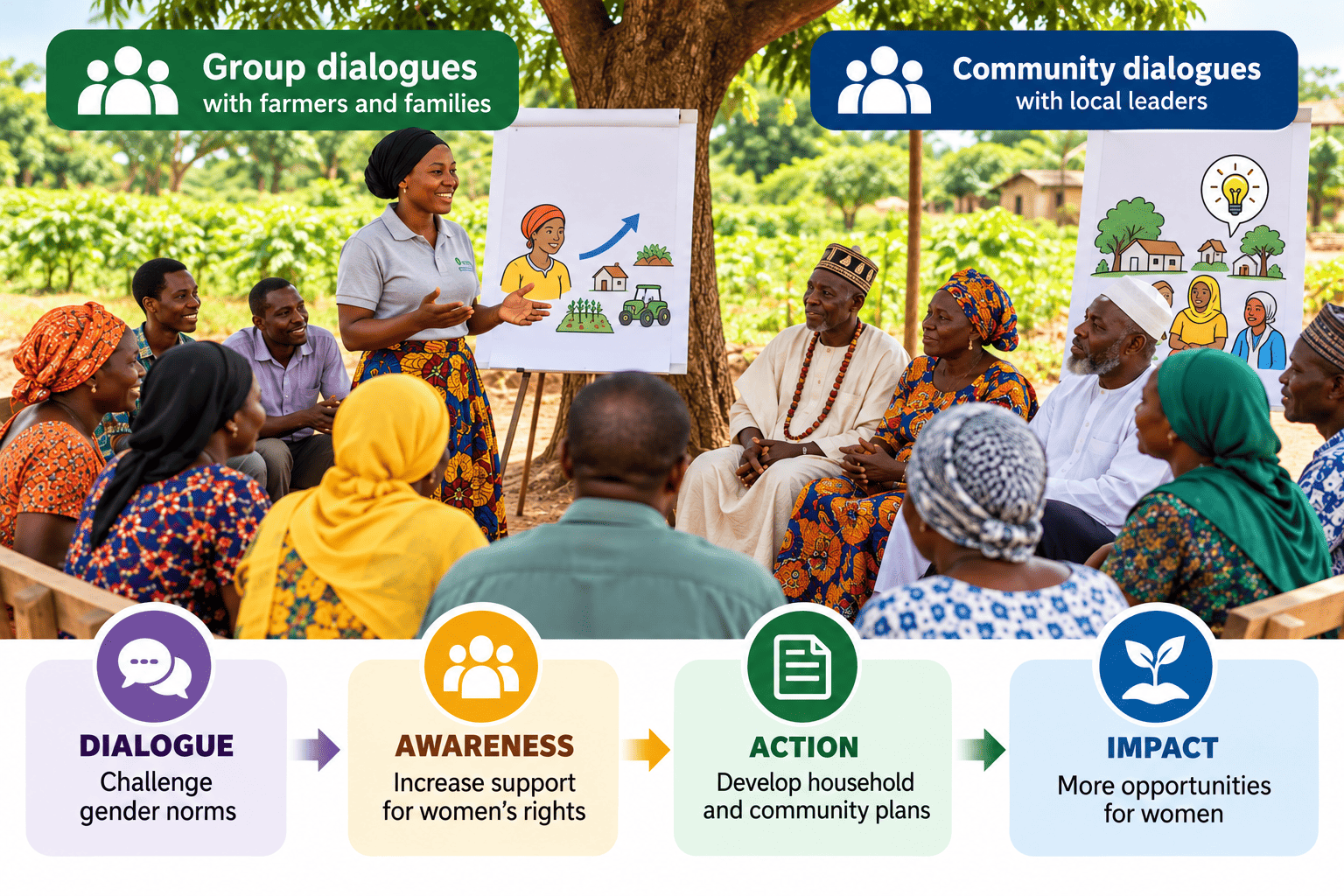
This technology is not yet validated.
| Target Groups | Positive Impacts |
| Women with limited or no land ownership |
|
| Women from low-income households |
|
| Young women in agricultural communities |
|
| Women facing restrictive social norms or limited representation in community decision-making |
|
Farmer climate change readiness: Significant improvement
By challenging resrictive gender norms, implementing gender transformative approaches in the cassava agrifood system will enhance the capacity for women's economic resilience to climate change challenges.
Gender inequality in land ownership: Women face social and cultural barriers to owning and controlling land and other productive assets. The source identifies this as a structural constraint but provides no quantitative estimate of the gender gap.
Limited participation in agriculture: Restrictive gender norms limit women’s participation in cassava production, processing, marketing, and related businesses.
Unequal decision-making power: Women often have limited authority over land use and other productive resources within households.
Reduced productivity and profitability: Limited access to productive assets constrains women’s ability to improve agricultural productivity, profitability, and economic resilience.
Persistent community-level barriers: Social norms and attitudes can reinforce inequalities in women’s access to resources and economic opportunities.
Promote gender-equitable land rights: Address restrictive social norms that limit women’s ownership and control of land and productive assets.
Strengthen household dialogue: Engage women and men in structured discussions to encourage equitable access to resources and shared decision-making.
Mobilize community leaders: Engage traditional rulers, religious leaders, youth leaders, and other stakeholders to identify barriers and promote change.
Develop community action plans: Support practical actions to expand women’s access to land and productive assets.
Integrate gender-transformative approaches: Incorporate the dialogue sessions into agricultural policies, extension services, and rural development programmes.
Gender Dialogues for Women’s Land and Asset Rights is a gender-transformative approach that enables governments to address restrictive social norms, promote women’s ownership and control of productive assets, and strengthen equitable participation in agricultural value chains through structured group and community dialogue sessions. This approach contributes to SDG 1, 2,5 8. To integrate this approach into public agricultural programmes and community development initiatives, governments should consider the following actions and prerequisites:
Identify priority communities and target groups where women face barriers to land ownership, control of productive assets, and participation in agricultural value chains, particularly in cassava-producing communities.
Engage relevant stakeholders including farmer groups, women and men, traditional rulers, religious and youth leaders, family heads, and farmer and market leaders.
Select and prepare facilitators to lead the dialogue sessions collaborating and using the facilitator guides developed by IITA, JDPC Ibadan, and the CGIAR Gender Equality and Inclusion Accelerator.
Conduct group dialogue sessions using the facilitator guide comprising six modules and 12 sessions to encourage critical reflection, challenge restrictive gender norms, strengthen support for women’s asset rights, and promote equitable household decision-making.
Organize community dialogue sessions using the 11-session facilitator guide to engage community leaders in identifying barriers to women’s ownership of land and productive assets.
Facilitate collective reflection and problem-solving through discussions, brainstorming, and practical exercises that help participants identify opportunities to promote women’s rights and overcome existing barriers.
Develop household and community action plans that define practical measures to improve women’s access to and control over land and productive resources.
Integrate the approach into existing public programmes by collaborating with agricultural extension services, farmer organizations, and development institutions to facilitate implementation within agricultural and rural development initiatives.
Conduct follow-up monitoring and evaluation to assess changes in attitudes, household decision-making, women’s participation, and access to and control over productive assets.
Establish follow-up mechanisms to support the implementation of community action plans and sustain engagement with local leaders, farmer groups, and households beyond the initial dialogue sessions.
Open source / open access
Scaling Readiness describes how complete a technology's development is and its ability to be scaled. It produces a score that measures a technology's readiness along two axes: the level of maturity of the idea itself, and the level to which the technology has been used so far.
Each axis goes from 0 to 9 where 9 is the “ready-to-scale” status. For each technology profile in the e-catalogs we have documented the scaling readiness status from evidence given by the technology providers. The e-catalogs only showcase technologies for which the scaling readiness score is at least 8 for maturity of the idea and 7 for the level of use.
The graph below represents visually the scaling readiness status for this technology, you can see the label of each level by hovering your mouse cursor on the number.
Semi-controlled environment: testing
Common use by projects connected to technology providers
| Maturity of the idea | Level of use | |||||||||
| 9 | ||||||||||
| 8 | ||||||||||
| 7 | ||||||||||
| 6 | ||||||||||
| 5 | ||||||||||
| 4 | ||||||||||
| 3 | ||||||||||
| 2 | ||||||||||
| 1 | ||||||||||
| 1 | 2 | 3 | 4 | 5 | 6 | 7 | 8 | 9 | ||
| Target Groups | Positive Impacts |
| Women with limited or no land ownership |
|
| Women from low-income households |
|
| Young women in agricultural communities |
|
| Women facing restrictive social norms or limited representation in community decision-making |
|
| Target Groups | Unnintended Impacts | Mitigation Measures |
| Women with limited or no land ownership |
|
|
| Women from low-income households |
|
|
| Young women in agricultural communities |
|
|
| Women facing restrictive social norms or limited representation in community decision-making |
|
|
| Target Groups | Barriers to Adoption | Mitigation Measures |
| Women with limited or no land ownership |
|
|
| Women from low-income households |
|
|
| Young women in agricultural communities |
|
|
| Women facing restrictive social norms or limited representation in community decision-making |
|
|
| Country | Testing ongoing | Tested | Adopted |
|---|---|---|---|
| Nigeria | Testing ongoing | –Not tested | –Not adopted |
This technology can be used in the colored agro-ecological zones. Any zones shown in white are not suitable for this technology.
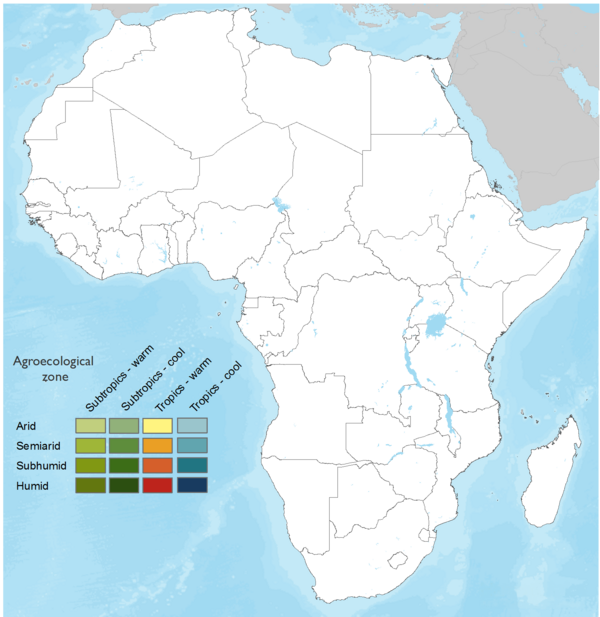


| AEZ | Subtropic - warm | Subtropic - cool | Tropic - warm | Tropic - cool |
|---|---|---|---|---|
| Arid | – | – | – | – |
| Semiarid | – | – | – | – |
| Subhumid | – | – | – | |
| Humid | – | – | – |
Source: HarvestChoice/IFPRI 2009
The United Nations Sustainable Development Goals that are applicable to this technology.
Promotes women’s economic opportunities through more equitable access to productive assets.
Supports women’s participation and productivity in agriculture, contributing to household food and nutrition security.
Challenges restrictive gender norms and promotes women’s ownership and control of land and productive assets.
Last updated on Oct 20, 2026
This technology can be used in the colored agro-ecological zones.




Gender Dialogues for Women’s Land and Asset Rights
https://e-catalogs.taat-africa.org/gov/technologies/gender-dialogues-for-womens-land-and-asset-rights/embed
Last updated on 20 October 2026, printed on Oct 22, 2026
Enquiries e-catalogs@taat.africa